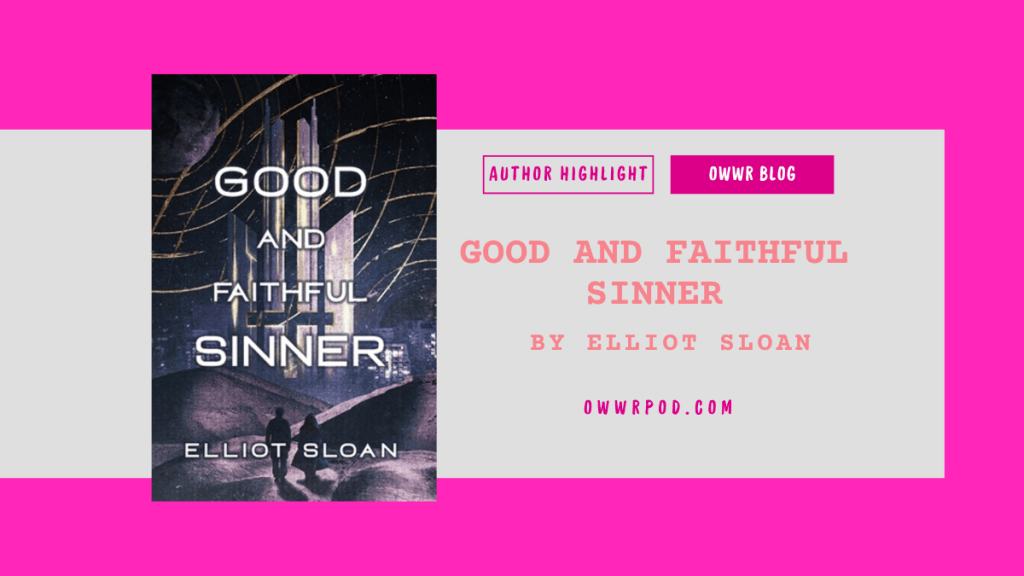
I, Hannah, met Elliot during undergrad when they were working with my sister and my sister thought we would make fast friends. I instantly loved their openness, personality, and amazing energy. I haven’t seen them since they moved to Minnesota, but I was thrilled when I saw that they were publishing their first book, Good and Faithful Sinner. I can’t wait to read this book! And they were so kind to sit down and discuss their work with me, out today!
- What made you want to be a writer?
I’ve been writing all my life both creatively and academically. I finally got the courage to lean in to the creative about 5 years ago after finishing my PhD. I was burned out on the achievement focus of my life and creative writing was like medicine! Once I started I couldn’t stop. I write more or less every day
- What can you tell me about your book?
Good and Faithful Sinner is an adult dystopian sci-fi with two POVs. Asher is a faithful soldier struggling to reconcile his faith and family responsibilities with his repressed sexuality and his ever-growing list of questions about his world. Revera is a trans woman working undercover in the heart of the theocratic government. Mysterious deaths and budding romances lead both Asher and Revera into an underground rebellion rallying behind the biblical symbol of the Mark of the Beast. Good and Faithful Sinner is a story about breaking silence, reclaiming joy, and daring to imagine a life beyond the boundaries of belief. Expect found family, a twisty plot, lots of action, and a spicy MM romance subplot.
- What excites you most about your story?
The setting is another planet and a strict hierarchical society, but it functions as a vehicle for examining a lot of very real, very present day issues in our own society. I really enjoyed exploring different elements of religious trauma, religious deconstruction, and reconstruction, and the guilt that often comes with difficult sibling relationships, all while getting to play around in one of my favorite genres!
- The worldbuilding in this book packs a punch! I’m impressed in the layering of science fiction with a neo-Christian belief system. I feel like it’s not something that’s often done, taking our true knowledge of Christianity and putting it into sci-fi. What was it like building this world, and how did you go about making a futuristic world while staying true to the theological beliefs of our world?
So… one thing about me is that if there’s a documentary about a religious cult – I have watched it. I grew up in a very culty environment (isolated ultra-fundie evangelical) and I am sort of clinically obsessed with this topic. When I got the idea for the world of Good and Faithful Sinner, I had been thinking a lot about founding texts for various cults. For reasons I cannot now recall – I was re-reading the book of Revelation in the Bible, and I just couldn’t stop thinking about what might happen if a group of people thought that THEY were the chosen 144,000 mentioned in the book of Revelation. And the world just sort of blossomed from there. Each of the different “churches” in the Seven Stars come from the churches mentioned in Revelation, and roles in society are determined by the characteristics described in those chapters. The sci-fi elements blended really easily for me – I’m a huge nerd so I had a ton of fun researching terraforming theories and FTL (faster than light) space travel theories. There are thousands upon thousands of words of world building documents that I produced while drafting this book that ultimately ended up supporting one or two sentences of text!
- What excites you most about your characters?
There’s a lot of ME in both Asher and Revera, but I’ve found that readers see themselves in them as well and LOVE that 🥹
- Asher is a difficult character. When we meet him, he is deeply ensconced in the Christian regime. I know we can expect him to start questioning this, but can you tell us a little bit about what it was like writing a character who will have to be deconstructed from starting in the military, to then go through questioning his faith and experience?
I pulled a lot from my own lived experiences for this part, but also, I have my doctorate in human development and family science, and my research has been focused on the lived experiences of LGBTQ people growing up in non-affirming Christian families. So I have thousands of hours worth of scholarly research to pull from in writing this as well. Ultimately, deconstruction looks so different for every person. No two paths are exactly alike, and not everybody arrives at the same destination at the end! I tried to represent multiple different paths through Asher, Revera, Ori, Zeneb, Euphrates, Nyx, and Gabriel.
- What I noticed about Asher was the fact that he started questioning not due to a big, seismic issue, but something that really hits his brain and doesn’t make sense to him. I feel like often deconstruction happens in smaller moments. What made you want to highlight something like this?
You are so right! It is often little things. Something that doesn’t sit right. Like a pebble in your shoe. We hear about these big “I came out and my family threw me out” moments – but more often the moments are small and they accumulate over time until a person reaches a breaking point. Another thing about Asher (and most people going through deconstruction) is that his path is not linear. He waffles back and forth multiple times throughout the story as he battles the fear and indoctrination. When safety has always been accessible ONLY through obedience, choosing to step outside of that is terrifying!
- On the other side of things we have Revera, who was so charming in the few short moments I got to spend with her. She is fighting against fascism and fighting for her found family, but she’s also dealing with profound grief as she does it. What was it like layering her experience into this novel?
Revera’s story really explores the survivor’s guilt that sometimes accompanies freedom. Sometimes you get out of a high control environment, you find peace and joy, but not everybody comes with you. And even if they do, not everyone thrives once they’re free. There’s so much pain in that, and a big part of Revera’s arc is really about learning to let go of that guilt. I don’t think I’ve ever met a queer person who WASN’T carrying some kind of grief. I wanted to represent that reality!
- Revera at the beginning gets an offer she can’t refuse, but we are left wondering what it is in the first few chapters. I have a feeling it will test her resolve though. Can you give us a hint of how she will fare?
In order to keep her friends out of prison, Revera agrees to go undercover in the Seven Stars, posing as a religious supplicant (basically a convert). She thinks of it like penance, to some degree—like maybe she can move on from the guilt of losing her partner by putting herself in mortal danger. She endures some wacky religious trials, and forms some unexpected friendships that push her further and further away from the tasks she was assigned by her government.
- Did you struggle with anything when creating your characters?
These characters are SO personal to me and my own lived experiences that a lot of the writing was painful in some ways! But it was more of a cathartic struggle than anything else 😊
- I know this is a dual POV, but is there another character in this book that you just adored creating that we can expect to see?
Euphrates (Asher’s love interest) is absolutely a favorite of mine. He’s sarcastic and sharp tongued and brave and adorable. Can’t wait to see how others feel about him! My other favorite side character is definitely Nyx! Nyx and Revera become close friends, and there’s so much about Nyx’s story and relationship to gender that is precious to me!
- Obviously not to pry, but I do know a little bit about your backstory with Christianity and how it inspired you to get your PhD in social work. Would you mind sharing a bit about your story with our listeners and readers?
I spoke about this a bit in my answer to question 6! But yeah, I grew up fourth of eleven in an extremely isolated fundamentalist christian family. Like… think the Duggers but worse because we didn’t have that TV money! I received no real education beyond reading and basic arithmetic. I was supposed to get married and have babies as early as possible. Since escaping that world, I have put myself through three degrees and am now a professor of Social Work with a PhD in human development and family science. My research focuses on the lived experiences of queer people like myself who grew up in non-affirming christian families. My lived experience and my scholarly work really undergird this story!
- What made you decide to go into Indie Publishing? What has the marketing process looked like for you so far for potential writers?
I went with a small indie publisher for this one! I queried for a few months but the word count on this book is a bit high for a debut (it has two POVs that don’t connect until like 2/3 through the book) so I ended up looking into small publishers instead. I landed with an awesome queer owned press and it’s been a great experience. I plan to query again for my next book as I would prefer to be less involved in my own marketing and have access to a larger potential audience! Social media marketing is just SO MUCH WORK for very little reward. Even the most consistent posting on the internet doesn’t guarantee anything. I’d love to not have to do so much of it next time around!
- What should readers expect from Good and Faithful Sinner?
I think that ANY reader can find a meaningful and emotional story of family, resilience, and self-discovery in this book. If you are a queer person who grew up religious, this book will probably make you cry once or twice. It might make you want to call your siblings. The world and the characters of Good and Faithful Sinner hold pieces of my own life, as well as lessons I’ve learned from the many incredible people I’ve met through my scholarship. As you read, I hope that Asher and Revera can share with you some of what I have learned: that you deserve to be loved exactly as you are, and that nobody else gets to tell you what is sacred.
- What books inspired you as a writer?
Babel and the Poppy War Trilogy by R.F. Kuang. The Broken Earth Trilogy by N. K. Jemison. Everything by Andrew Joseph White. The Red Rising Series by Pierce Brown. Portable of the Sewer and the Lilith’s Brood series by Octavia E Butler. The Left Hand of Darkness and The Ones Who Walk Away from Omelas by Ursula K LeGuin.
- What are you reading, watching, and/or enjoying?
I read the entire Realm of the Elderlings series (16 big books) by Robin Hobb this summer and I don’t know if I’ll ever be able to stop thinking about it.
Find Elliot here:


Leave a Reply