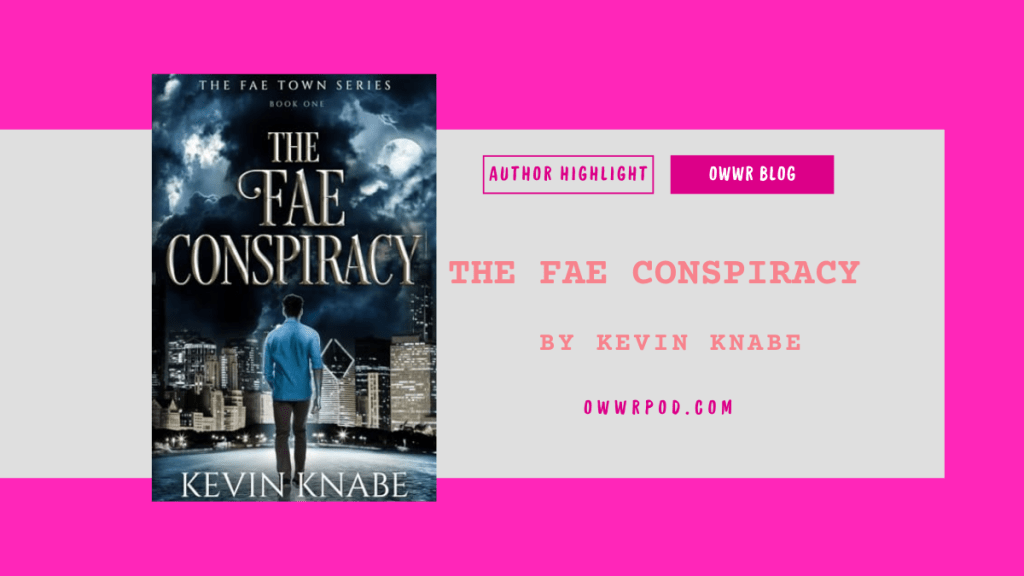
This is a special author highlight because Kevin is part of my, (Hannah’s) writing group! Kevin actually beta read a book for me, so I was so excited to have this written interview with him about his book. This book has it all – fae, compost, and people finding out those they trust may not be what they seem!
- What made you want to be a writer?
An old friend of mine, who is a phenomenal visual artist, and I once co-created a series of indie comics inspired by some of our teenage misadventures. The creative process was incredibly fulfilling and fun. When that project ended, I realized I did not want the storytelling to stop.
The problem was that I am not a visual artist. So I had to learn how to create all the cool visuals with words instead.
As I kept writing, I began to rediscover something familiar. The same joy I felt as a kid reading fantasy novels started showing up again when I was discovery-writing my own stories. That sense of wonder, of not knowing what would happen next, of stepping into another world. Except this time, I was building the world myself.
That feeling has never really gone away and I hope it never does.
- What can you tell me about your book?
The story follows a naïve dryad named Tanin who works at an organic composting facility in Chicago that is secretly infusing magic into the modern world. He believes he is helping the planet. He does not realize he is participating in something much larger.
When things begin to go sideways, buried agendas and hidden players come to light. What seemed like eco-activism reveals itself as magical acceleration.
Much of the inspiration came from contemporary spiritual discourse. If you listen to astrologers, channelers, and modern mystics, there is a recurring idea that humanity is moving through a period of heightened energetic frequency and rapid evolution. I took that kernel of thought and amplified it within an urban fantasy framework.
In my version, there are magical agents who are aware of this shift and are actively trying to speed it up. They are intentionally accelerating spiritual and energetic evolution through subtle and not-so-subtle magical interference. The novel explores what happens when evolution is forced rather than allowed to unfold naturally.
At its heart, it is a story about awakening, manipulation, and the cost of trying to rush transcendence.
- So this is purely urban fantasy (which I know for a fact you love writing!). What draws you to urban fantasy as a genre?
Urban fantasy has been my favorite genre since I was a kid. It lets the imagination run wild without requiring the full immersion that epic fantasy often demands.
Epic fantasy is incredible, but it asks for a significant investment up front. You have to learn new continents, political systems, cultures, magic rules, and histories before you can fully understand the stakes. That depth can be rewarding, but it can also feel like work in the early chapters.
Urban fantasy has a lower threshold for entry. The reader already understands the world. The only questions are when the supernatural entered it, how visible it is, and what flavor the magic carries. Once that framework is established, the story can move quickly.
What I love most is that urban fantasy overlays wonder onto the ordinary world. It invites you to walk through your own city and imagine what might be hiding behind the mundane. That blending of the familiar and the impossible is something my brain absolutely delights in.
It feels like permission to believe there is more going on just beneath the surface of everyday life.
- Your work looks at a dryad who is trying to help add magic through a very earthy way. What made you want to build this mix of Chicago city with a more earthy and environmental discussion?
It really came from lived experience.
My university degree is in Resource and Environmental Studies, and one of my courses focused on landfills. We visited a massive, almost surreal landfill outside Austin, Texas, where I saw innovative systems for managing waste, including compost rows large enough to break down a cow carcass in a matter of days. It was strange, industrial, and fascinating all at once.
My career as an environmental consultant has also exposed me to audits, historical site research, and the long arc of environmental remediation. I have spent years looking at how we clean up the messes we have made.
People often say “write what you know,” and in many ways I merged my love of urban fantasy with my professional life to create The Fae Town Series. Compost, landfills, remediation, and environmental systems became the perfect metaphorical soil for something magical.
One theme that emerged naturally from me was environmental stewardship. In my day job, I can contribute in practical and technical ways. In fiction, I get to go further. I get to personify the Earth itself. Gaia becomes an actual character and is able to voice what she thinks about the state of the planet.
I think if you are paying attention at all, it is clear we are facing real environmental challenges. The novel does not preach, but it does invite reflection. If a dryad were walking among us, helping to accelerate change, what would he see? And what would the Earth say if she could speak directly?
Urban fantasy gave me the space to explore those questions in a way that is imaginative, but still rooted in reality.
- What excites you most about your story?
The mashup of fantasy, environmentalism, and spirituality, all filtered through characters who became deeply real to me while I was writing them.
As the story developed, these characters stopped feeling like ideas and started feeling like people. They surprised me, challenged me, and carried emotional weight in ways I did not fully expect when I began.
More than the magical systems or the larger themes, what excites me most is how alive they feel. My hope is that readers connect with them the same way I did, that they feel invested in their choices, their awakenings, and the consequences that unfold around them.
If the characters resonate, then the world around them becomes real too.
- You did mention that you use chakras as a power source with inspiration from Gene Keys. Can you tell me more about why that idea fit with your story and the magic system?
Because the story is rooted in the idea of accelerated human evolution, it felt natural to draw from existing spiritual frameworks that already explore consciousness and energy.
I borrowed heavily from Eastern energy systems, including chakra theory and practices like qi gong, to build the magic system. In the novel, magic users move different “flavors” of power through their chakra centers, each aligned with the traditional qualities associated with those centers. It gave the magic a structure that felt symbolic, embodied, and psychologically meaningful rather than arbitrary.
Interestingly, I discovered Richard Rudd’s Gene Keys after I had already written the book. One of the ideas he discusses is the mutation or evolution of the solar plexus center in the coming years, particularly in children born after a certain point in time.
In The Fae Conspiracy, one of the inciting incidents is the emergence of a new energy center called the star chakra, blooming just above the solar plexus. Characters who activate this center gain access to expanded perception and new magical capacities. The thematic overlap between my fictional “star chakra” and Rudd’s ideas about evolutionary shifts in human energy was striking to me.
It felt like parallel inspiration. Different sources, similar symbolic direction.
I actually reached out to Richard Rudd’s team to let them know about the synchronicity. I have not heard back, but I appreciated the resonance. It reinforced the idea that creative concepts often emerge from a shared cultural or archetypal current rather than from any single origin point.
For the story, chakra-based magic worked because it ties power to consciousness. Magic is not just something you wield. It is something you become aligned with.
- What excites you most about your characters?
Their exceptional sensitivity.
The healthy fae characters are written with an expanded emotional range. They feel more deeply, love more openly, and respond with greater empathy and compassion than the average human around them. That heightened sensitivity gives them a kind of luminous intensity. In some ways, it even makes them appear almost neurotic when contrasted with humans who have learned to numb or shut down their emotions.
The main character, Tanin, is especially defined by this quality. He is a deeply empathetic being who approaches others with an almost radical level of love. Writing from his perspective gave me a lens through which to see every character with generosity and curiosity rather than judgment.
That was one of the most exciting parts of the process for me. Through Tanin, I could explore what it might look like to move through the world with near saint-level compassion while still navigating confusion, betrayal, and growth.
His sensitivity is not weakness. It is power.
- Did you struggle with anything when creating your characters?
The development of the characters took time. I wrote and rewrote the story several times before landing on the final version. But once I truly understood who they were, the trilogy almost wrote itself.
The biggest struggle was with villains.
Early drafts included more clear-cut antagonists. I had two characters, Viron and Chandron, who were overtly evil in their own ways. Conceptually they worked, but on the page they made the story feel flatter and more two-dimensional than I wanted.
What I eventually discovered is that straightforward villainy did not serve this world very well. The story became more compelling when the antagonistic forces had complexity, layered motives, and even understandable logic. Once I shifted away from obvious “bad guys” and leaned into moral ambiguity, the narrative deepened.
Viron and Chandron never made it into the published version for that reason. But I have a feeling they are not gone forever. Sometimes discarded characters simply wait for the right story to inhabit. I would not be surprised if they return one day in a new form.
- I have actually read another of your series in our mutual writing group. You seem drawn to characters who have lived a difficult life but find themselves gaining an enlightened personality, and how to balance those two sides of them. What draws you to that type of character, and can you give readers a deeper look into Tanin in The Fae Conspiracy?
I did not start writing novels until I was forty, during a painful divorce that coincided with the isolation of COVID. That period became a creative awakening for me. I began discovering parts of myself that had either been dormant or undernourished for decades.
Integrating those new, very real aspects of myself into an already established adult identity was not simple. It was uncomfortable at times. But it was also one of the most satisfying things I have ever done. Building and sustaining a creative life felt like reclaiming something essential.
I think that process naturally finds its way into my characters. I am drawn to people who are not blank slates, but who carry history, wounds, and complexity. The tension between who they have been and who they are becoming is endlessly interesting to me.
Tanin embodies that tension in a different way. He is not hardened by trauma in the traditional sense. Instead, he is almost too open. Too sensitive. A sheltered transplant to Chicago from a lush and exotic Pacific island, he is literally a living tree with the markings of a rainbow eucalyptus. A walking prism of color in a gray city.
He is magnetic. Meditative. Deeply devoted to the cause of infusing magic back into the world. He believes in the goodness of the mission and trusts his mentors.
But as he begins to question the cost and hidden consequences of their “good work,” his awakening takes a more difficult turn. He must release blind trust in authority and learn to trust his own perception. That shift from innocent devotion to self-authority is where his real growth happens.
At his core, Tanin is a being of radical empathy navigating a world that is far more complicated than he first imagined. Watching him hold onto his sensitivity while growing stronger and more discerning was one of the most meaningful parts of writing the story.
- You have two characters – Tuan and Tanin, who are thrown together in this plot but have very different backgrounds. Was it fun playing around with their different perspectives and experiences?
So much fun. Although in hindsight, I probably should have given them less similar names.
Tuan serves as the grounded, ordinary human perspective. He begins as a bit of a fan of the fae, almost starstruck by their beauty, power, and apparent enlightenment. Through his point of view, readers get to experience that same sense of awe. He holds the fae on a pedestal.
Over time, that pedestal slowly comes down.
As the story unfolds and Tuan grows closer to the magic, he begins to change. Proximity transforms him. What starts as admiration evolves into participation, and eventually into empowerment.
Tanin, on the other hand, offers the inverse lens. He is a magical being who is fascinated by ordinary humanity. Where Tuan sees the fae as elevated and otherworldly, Tanin sees humans as complex, resilient, and worthy of love.
Writing them together allowed me to explore that mirror dynamic. Tuan is a regular man in awe of magic. Tanin is a magical being in love with the ordinary world. Through each other, they discover that the divide between human and fae is not as wide as it first appears.
Their relationship becomes a conversation about projection, idealization, and ultimately equality. And yes, it was an absolute joy to write.
- This is not a shock because it happens in the first page – but we find out that the characters in this book could be put in danger and be commodified if they were ever killed. That is a huge motivator for them. What made you want to bring that in as a danger and how does that affect the story as we read it?
Because the dryads are living trees who experience reality on a more luminous emotional plane than humans, I loved the idea that their lives would distill into something tangible after death.
In the world of the story, when a dryad dies, their body breaks down into magical “death seeds” that reflect the emotional signature of their life. Those seeds are then cultivated by Newgrowth into what the company markets as emo-plants. Each plant carries the emotional frequency of the dryad it came from. Stand near a hilarity plant and you start laughing. Proximity to an anger plant makes your blood heat. They are botanical distillations of lived experience.
The concept of compressing a being’s emotional essence into something physical completely captured my imagination. What would the seed of a compassionate life produce? What would grow from bitterness? From devotion? From corruption?
Once that idea existed, the danger followed naturally. If a dryad’s death produces something powerful, rare, and profitable, then their bodies become commodities. They are no longer just beings. They are resources. That reality creates an immediate undercurrent of threat in the story.
Those death seeds become increasingly important as the trilogy unfolds, particularly in the second book.
Interestingly, after writing the series, I learned that in certain Buddhist traditions there is a belief that crystalline relics can form in the remains of highly realized practitioners. The resonance between that concept and my fictional seeds was striking. Another example of parallel ideas emerging independently.
At its core, the concept explores a simple but unsettling question. If your inner life could be harvested, what would it grow into?
- I was so excited with what I read of your work – a compost facility with more to the story, questionable plans from mentors and more! Can you tell readers what they can expect from your story?
The Fae Conspiracy is the first book in a trilogy that follows a Chicago neighborhood and the magical beings quietly living among its residents.
Readers can expect a layered urban fantasy that blends environmental themes, spiritual evolution, and moral ambiguity. What begins as a story about a composting facility with a secret mission slowly unfolds into something much larger. There are hidden agendas, mentors whose motives are not entirely pure, and a growing sense that accelerating magic back into the world may come at a cost.
The story explores awakening from multiple angles. Personal awakening. Cultural awakening. Even planetary awakening. As the characters discover what is really happening behind the scenes, loyalties are tested and assumptions are challenged.
At its heart, it is a story about trust, agency, and the danger of believing you are on the side of good without questioning the methods being used.
Readers can expect magic grounded in emotional and spiritual symbolism, relationships that evolve in surprising ways, and a trilogy that grows in scope with each installment.
- What made you decide to go into Indie Publishing? Can you describe for the readers what the process looked like for you?
Oof. That is a long answer.
I felt a deep personal drive to get my work out into the world without a gatekeeper. Indie publishing was not just a business decision for me. It was about agency. I wanted to prove to myself that I could finish a novel and place it directly into readers’ hands. Publishing independently fulfilled something personal and powerful.
That said, I made just about every mistake a new indie author can make.
At the beginning, I hired an imprint of Hay House called Balboa Press to handle all the pieces I did not want to learn. Professional editing, cover design, formatting, ISBN acquisition, marketing, and distribution. I was deeply trusting of the process and spent thousands of dollars on services they offered.
In the end, I lost that money and took the long route to learning everything I had hoped money would shortcut.
That experience became an education. I learned that the real freedom of indie publishing is not simply skipping traditional gatekeepers. It is becoming the publisher yourself. It means understanding the production process, owning your ISBNs, hiring editors directly, directing your cover design, managing distribution, and controlling your marketing strategy.
For new or aspiring indie authors, I would offer this. Publishing services can make sense in some cases, but go in informed. The business side of indie publishing can feel overwhelming at first, but it is not harder than writing a novel. It simply requires patience, research, and a willingness to learn.
Once you do, the control and creative sovereignty are worth it.
- What books inspired you as a writer?
The Magicians by Lev Grossman showed me that urban fantasy could be literary, gritty, brutal, and unapologetically moody. It proved that magic stories do not have to be whimsical or escapist. They can be psychologically raw and emotionally complex.
Elfquest has been with me since I was eight years old. That series deeply influenced the way I write magical beings. The elves in that world were powerful, but they were also extraordinarily sensitive. Their emotional lives were vivid and intense, and that shaped how I approach the fae in my own work.
And of course, The Dresden Files by Jim Butcher gave me confidence that there is a strong appetite for Chicago-based urban fantasy. Seeing the city used as a magical playground made it feel possible for me to root my own stories there.
Each of those works influenced me in a different way. Tone. Emotional depth. Setting. Together they helped give me permission to tell the kind of story I wanted to tell.
- What are you reading, watching, and/or enjoying?
I usually have about five audiobooks going at once. It is a rotating mix of fiction and non-fiction.
Right now in my Audible library are Twelve Months by Jim Butcher, The Bright Sword by Lev Grossman, The Science of Magic by Dean Radin, Redneck Revenant by David R. Slayton, and Practical Magick by Mitch Horowitz. That lineup probably says a lot about me. I like my magic layered. Some literary, some gritty, some speculative, and some metaphysical.
On the television side, this winter I have gravitated toward reality-based game shows like The Traitors and MrBeast Games. Watching people make split-second decisions under pressure has been unexpectedly fascinating. There is something psychologically revealing about high-stakes environments.
I also binged Shrinking on Apple TV while I was down with the flu and loved it. It had humor, vulnerability, and heart in a way that really worked for me.
So at any given time, I am usually balancing magic, psychology, and human behavior in one form or another.

 On Wednesdays We Read Podcast
Leave a comment