- What made you want to be a writer?
I’m an illustrator also so it kind of goes hand-in-hand to both write and draw my stories. I cannot think of one specific time I thought I wanted to BE a writer, but instead always felt it was just something I would do, whether it was my full time job or not.
- What can you tell me about your book?
When a robot built for construction work first sees an angular, sleek prototype military robot slink onto the base he’s working outside of, he immediately falls in love. The problem is, only anomalous bots understand the concept of love, and the lowly laborbot has not deviated from his default programming once. So he thinks, anyway. When the laborbot is scheduled for decommission, the military bot cannot possibly live without him, and the two bots set out on a path to find the fabled anomalous robot utopia Root.
- I’m in love with this premise already. A loving robot is everything I want. What was it like building this militaristic world mixed with love and utopia?
Thankfully, the military is just one aspect of this world. There are many complex areas of living where it’s just humans, just robots, or robots and humans coexisting. This story focuses mainly on these two bots who seem to decide on love against all odds, and choose to chase that ideal place where they can see it unfold. I love contrasting hard with soft in both my writing and my art – a robot built for killing making the executive decision that not exclusively killing is the best path forward is such a fun seeming contradiction to write.
I am also going to lovingly report I appear to be stuck in this world, for the time being.
- What excites you most about your story?
I’m a long time lover of sci-fi. If it’s got a robot in it, you bet your butt I’m going to watch/read/play the thing. So, finally sitting down and putting down on paper what I really love about robots and stories about robots finding themselves and divorcing themselves in many ways from humanity was most exciting. I’ve said this book is my “love letter to sci-fi” but the thing is, there’s still so much to tell, and I have a lot more love for the many, many years of enjoyable sci-fi out there to express onto pages. There’s a lot of opportunity for stories here, and not a lot in the way of constrictions. There’s so much happening between lines and pages and chapters elsewhere that I can dive into. The bots give a lot of information, but even they are limited to knowing the whole, and the potential for it is wildly thrilling for me to think about.
- What is something you struggled most with while writing?
One of the things I worried most about before publishing was that people would find one of the main characters who comes off as a bit of a grump (Zev) to be not likable – I’m so glad that’s not the case. Writing him is a lot of fun because he’s very analytical, and he just says exactly what he’s thinking, which can come off a bit frustrating at times. Thankfully, people understood. Objectively seeing your characters can be difficult, and I try my best. Sometimes it works out, and sometimes it doesn’t.
- I know you said you worried about Zev being a bit grumpy, but I also really like how he seems to be different based on his militaristic background. What was it like building him as a character? And can you tell me more about his wolf obsession without too many spoilers?
He is quite the interesting character for plenty of (spoilery) reasons. By nature he’s mysterious, and he says very little about himself that isn’t available already as public record, even to his construction bot beau Sterling. Since the book is from Sterling’s point of view, I tried to show as much of him as was intriguing, without tipping my hand and spoiling all of his secrets. Even Sterling, who knows him best, both physically and mentally, feels despite knowing what he’s made of (eventually), that he’s never going to fully unravel all of the mysteries that make up Zev, and I think that’s a really fun shadowy area for a character to exist in. What it means for me as a writer is that he can go in any direction, even if it happens to be one that the other characters don’t fully agree with.
One of the most fun parts of the story is when the two bots decide they would like to have names and decide to name each other. It’s not that much of a spoiler, but it is an establishing relationship point. When Sterling chooses Zev’s name he does not have any knowledge of what the name means, but like anything, when Zev is presented with something, he reaches out to find everything he can about that thing and form an opinion or decision around it. Sterling didn’t know the name “Zev” means wolf, and Zev didn’t either until Sterling presented it to him. In that second before accepting it as his name, Zev does the instant backwork of researching it to determine if he finds it acceptable, and in learning about wolves, perhaps he likens himself a bit to one in the process.
Since robots functionally absorb the world in an entirely different manner than humans, Zev subsequently asking Sterling if he’s ever seen a wolf before means he wants to absorb bot-created information about these wolves. Basically – Sterling unknowingly blessed him with this likening of a wolf, and Zev found it acceptable, perhaps even a little enjoyable.
- What excites you most about your characters?
I love that, despite these guys being bots, they’re actually relatable.
- Something I loved right at the beginning was robot gossip – was it fun building in those little details to really throw the reader into characters?
I’m a character driven kind of writer, so first and foremost I try to make the characters as believable as possible. I love this idea of an entire undercurrent of a wholly different world that’s completely separated from the human world, slightly different, but largely the same. These levels continue throughout the whole book and beyond, because we have private conversations, botnet conversations, and then other sub-nets for like-bots/makes/models and other organizational groups. I found it hard to believe that you could put a bunch of autonomous machines together into what is essentially a group chat and not have them start gossiping in a way… Give them a means to connect with other bots and they’ll find a way to make gossip out of it. Inix finds bot gossip dry and dull, but I think figuring out the kind of truthful-yet-teasing jabs a bot might lightheartedly send out to other bots it is in contact with to be fun. And yes, it’s very entertaining to write and I love including details that make readers go “oh but of course that would happen.”
- I noticed a lot about communication and naming at the beginning of the story – the robots discussed how they communicate, how they may have mixed views of the other’s communication or “likes”, etc. What made you interested in looking at communication or personhood for robots?
What it comes down to is I wanted to look at what happens when you take a being that has all (or limited) knowledge preloaded into it, fire it up for the first time, and then tell it to just have at it. Of course something like this would develop its own quirks, its own likes, its own dislikes, but with no context (no other bots to meaningfully compare to), it might not understand it as exactly that, or might not know it’s even possible to have an opposing viewpoint. For example, Zev is built as a killing machine, so the most efficient way is through (most of the time), and when he faces pushback on it, this confuses him. The bots do a lot of back and forth (“Explain.”) asking one another to extrapolate in ways they can digest so they can understand how the other arrived at the conclusion they did, and I feel like if we did that in real life, discussed things through rather than knee-jerking into “because I just don’t like it” as an answer, we could perhaps get more people on the same page about a lot of ideas and concepts. I liked the idea of bots basically comparing notes and quickly coming up to speed about how they should perceive the world and their roles in it, and how they may be more efficient at doing this than us humans because they don’t have pesky things like feelings to get in the way.
Just kidding. Spoiler: the bots definitely, definitely have feelings.
- What can readers expect from your story?
Coziness, to a degree. You’ll probably feel warm reading it and coming into it alongside all of these bots. A bit of action. Some dystopia. A whole lot of heart and hopefulness despite even some of the worst circumstances.
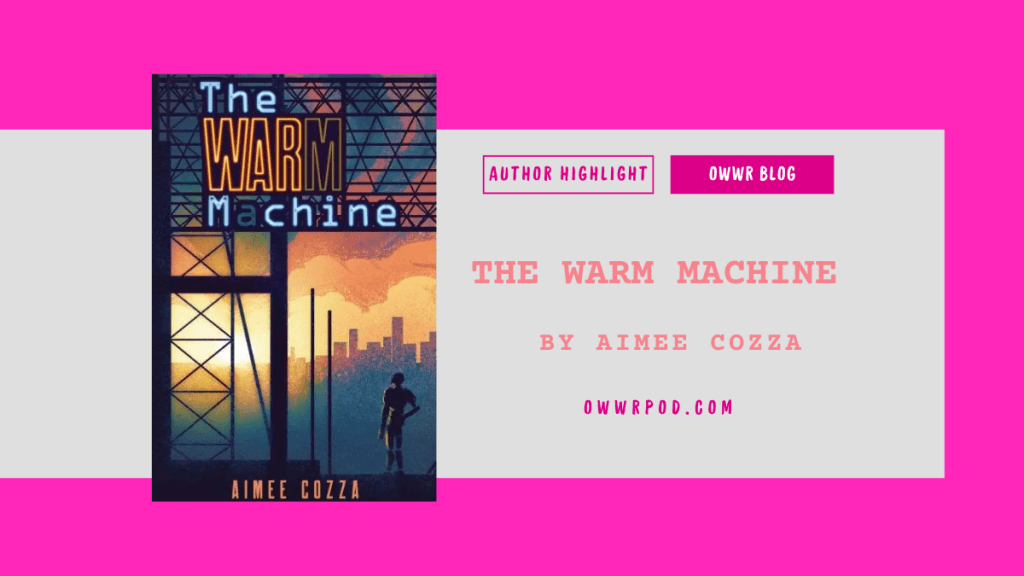
- I know you are an illustrator, so let’s talk your cover! It is amazing!!! Please tell me about what went into the design, and what it was like designing your own cover!! And the design of the FLC Series in the inside!
Why, thank you very much! I’ve actually never shown this before, but I’m putting it together for you now:
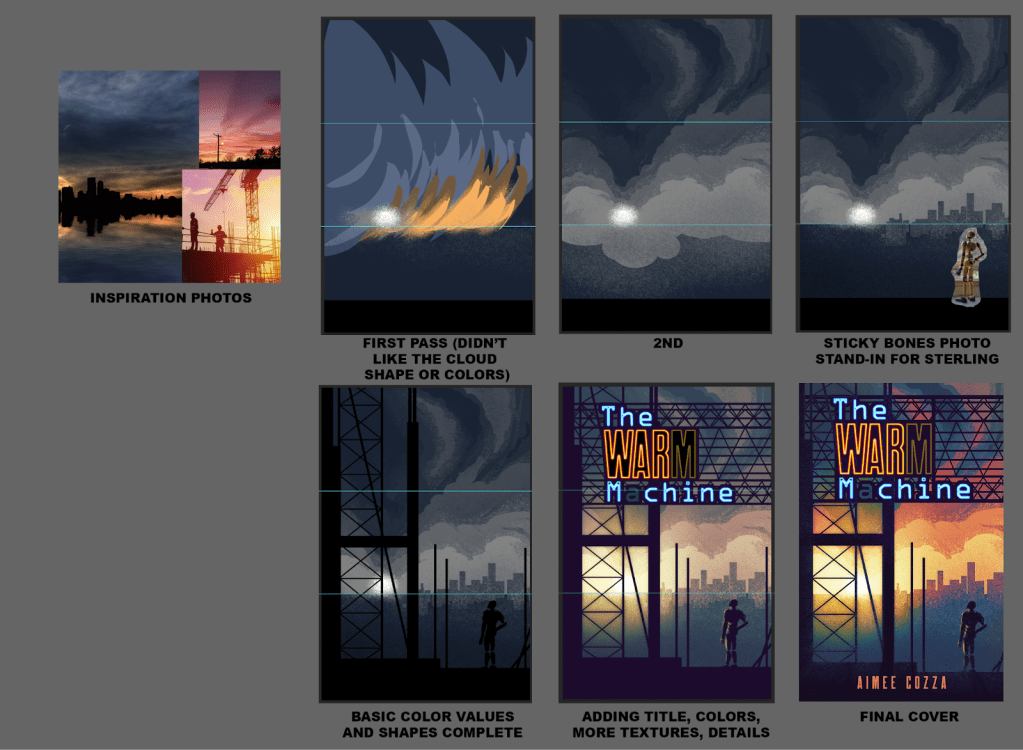
An in progress shot of me making the cover image!
This comes with a little backstory, too. Originally, I drew a cover work that was just supposed to be a stand-in as I was trying to figure out whether to keep the book private, try for trad publishing, or self-publish the book. I like making mockup covers for most of my stories, so this is just something I personally enjoy doing. So, I made a cover, it wasn’t a very good one. It was supposed to be the shoulder of the FLC0776 model with the title text printed on the plating there, but I drew it very quickly and didn’t put a whole lot of effort into it.
I used this artwork as just a stand-in during the crowdfunding phase. I was going to have backers vote on a new cover artwork for me to draw, as I was never happy with that work to begin with. Someone remarked that the shoulder plate looked like a butt, and I had a huge laugh over it. Decided to roll with it. Created a variant cover leaning into that butt idea.
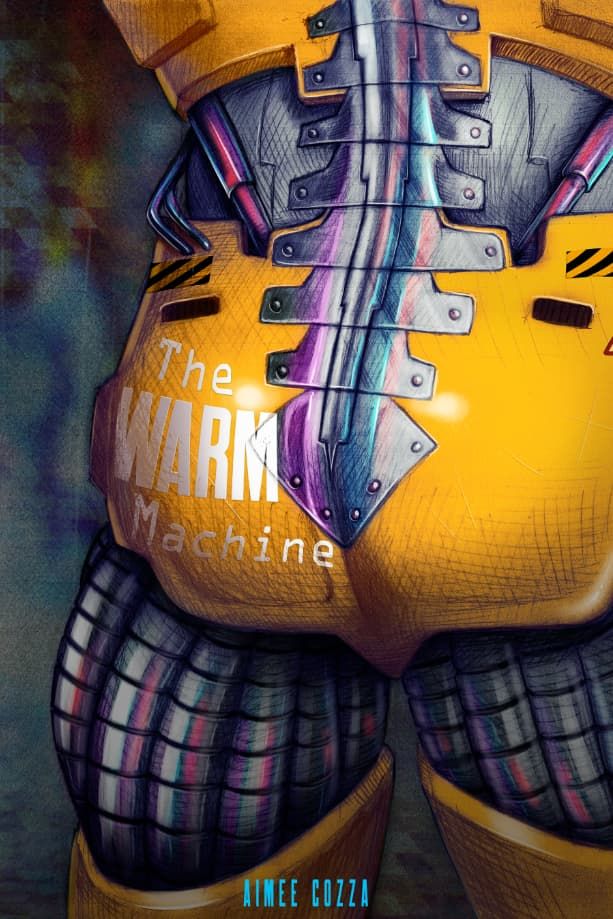
This became a bonus print for the campaign, but it was a lot of fun to do.
But, like I said, I was having the backers vote on a new cover artwork, and I had put together this, the original, some instruction manual style artworks (like the one on the inside), and what you see as the cover now. I don’t want to ask people if they want something I’m not capable of providing, so I sat down over the course of a few weeks and made all of the covers for the backers to vote on. As soon as I drew the cover as it is now, I went, “damn, I don’t even want them to vote, I think this is going to be the winner.” Very proud it made it through the backer voting process too.
- What made you decide to go into Indie Publishing?
After a year of querying a different title (and being rejected at every turn) and getting every short story rejected by many publications, I decided to indie publish my first words book – this novella. I wanted to know if I had a chance, if my writing was any good at all, if people would be open to my ideas enough that they would pay money and read. It felt like the only way to try this and find out was indie publishing. Turns out, people do like my writing.
- Can you describe to readers what your indie publishing process looked like?
All indies are different, but this is how it goes for me:
- Write the book’s first draft. However long it takes! Beginning to end, as complete as possible.
- Read the book, beginning to end, at least once. Make general notes as you go but do not edit.
- Going from your notes, add, remove, or fix things as necessary.
- Head into second draft. Rewrite your first chapter(s) definitely and entirely, because you’re a different writer than you were when you wrote it. Work through your next draft until you feel satisfied that your read through is smooth.
- Self-edit thoroughly, cutting fat and confusion, and fixing as many distracting typos or grammatical errors as you can.
- Go through an alpha and/or beta reader period. Read your story out loud to someone. Send those people reading it a detailed questionnaire about areas of the story you may be unsure about and tap them for additional areas of improvement. Listen to what they say and try to implement as many good-faith changes as you can. Not all beta readers are the same so do your best to determine who is giving you good feedback and who is not.
- Polish up another draft of the book.
- Send your last draft (it may go through multiple drafts/revisions!) to a professional editor.
- Start preparing for launch. Determine if your pre-order period is a traditional pre-order of a crowdfunding campaign.
- Spend at least 3 months preparing for your pre-order period/crowdfunding campaign and making sure you really cross all your Ts and dot all your Is so you don’t come away from your “one shot” feeling like you could have done more.
- Tap other indies for inspiration and knowledge. They are your friends, not your competition. Cross promo them, cross pollinate one another, and uplift each other the best you can because it’s a lot better together.
- Launch your pre-order period and try not to hold your breath.
- Order and proof, proof, proof, PROOF. That means read your book beginning to end when it’s in your hand so people don’t end up with a sub-par end product. Very important.
- Fulfill your pre-orders and prepare it all again for actual launch.
- Book birthday! (Launch)
- Ask people to leave reviews until the end of time. 😛
- What books inspire you as a writer?
It is hard to say. I read a lot of books as a child, but mainly they were anything I could get my hands on. I’d get books from the library, or books from my parents, or read scripts and magazines. I wasn’t much of a re-reader (I’m still not), so I never held onto one or two titles that made me go “I want to write like this.” I would like to think that I pulled influence and was inspired a little bit by every thing I read, no matter the genre or type of publishing.
- What are you reading, watching, and/or enjoying?
Currently:
Reading: Graft by Madeleine Marie-Rose, with Lesbians in Space: The Sapphics Strike Back next in my TBR pile.
Watching: The Pitt, Fallout, Pluribus, Stranger Things (who isn’t)? Watched Predator: Badlands last night and thoroughly enjoyed it.
Everyone go and pick up The Warm Machine and its follow up, The Lucky Machine, book 2, which came out in January! Go pick it up today.

 On Wednesdays We Read Podcast
Leave a comment