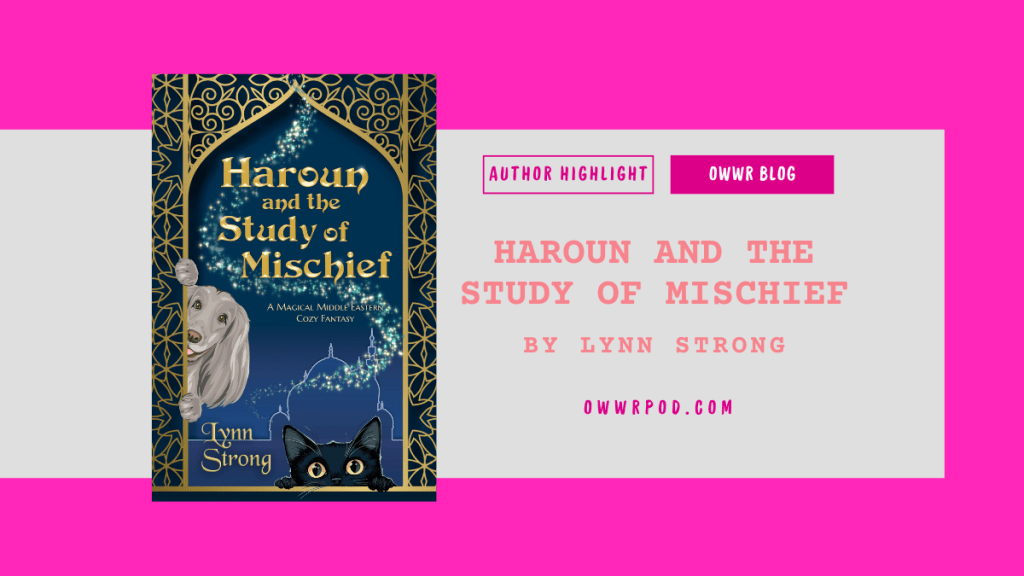
Hannah was so lucky to get to talk with Lynn Strong online about her upcoming book (OUT SATURDAY) Haroun and the Study of Mischief. This cozy fantasy has two new friends, adorable dogs and cats as characters (and an even more adorable human who is trying his best!), and amazing representation! Make sure if you like what you hear, that you go and preorder for the upcoming release!
- What is your book about? Please give a small synopsis.
“Don’t get a torch too close to his djellaba.”
“It might catch fire?”
“You might see it.”
Venerable Haroun, the blind saluqi priest of the dog-headed god Yepuet, has come to the wild and collarless Tel-Bastet, the City of Cats, for an education in mischief.
And Haroun has never met a crime of fashion he wouldn’t commit.
Shai Madhur, the disabled human priest of Upaja, thought accepting Haroun’s leash meant being Haroun’s seeing-eye human. He wasn’t prepared for the political machinations… or for Haroun’s sense of humor.
When a kind prophet-prince goes missing, Haroun smells iniquity in the air. (Iniquity, it turns out, smells like kumiss spilled on a tomcat in dire need of a bath.)
The problem with everyone in Tel-Bastet knowing what a Good Boy their Shai Madhur is, is that people keep trying to rescue him, whether he needs it or not. Not that he’s complaining, exactly. But Madhur swears he is never going carousing again… no matter how soulful Haroun’s puppydog eyes are.
With a splash of Studio Ghibli, a sprinkle of Roshani Chokshi, and a dash of Terry Pratchett, when the cats and dogs need to learn to live together, Haroun and Madhur take on the difference between what is seen and what is true.
- What made you want to be a writer?
I can’t remember a time I wasn’t either reading or writing. More recently, having become multiply disabled by Long COVID, writing is one of the most accessible remaining forms of creativity that I have: I can do it in small bursts, on whatever device I can handle.
- So Haroun and the Study of Mischief is a mystery with a missing prophet-prince. What was it like building out the mystery, making sure there were enough breadcrumbs for readers, while keeping them in the dark?
Honestly it isn’t architected the way most mysteries are – most mysteries who have “X and Y, They Fight Crime” as their base are kind of assuming their mystery-solvers are in any way competent or qualified to solve mysteries! Whereas this is the cozy fantasy version of things where, when the shahzada goes missing, Madhur and Haroun don’t even know if there has been a crime at all. They aren’t experienced detectives. They don’t even know whether the shahzada is wisely hiding from some Big Drama, because he already did hide behind the statue of Bastet in order not to be found during the first instance of Big Drama in the book. But on the other-other hand, none of the Powers that Be were taking action to try to find out why he was gone, and Madhur and Haroun were worried about him. So they set off into the Tel-Bastet nightlife with no idea what they were doing, and this particular story is about the adventures they had on the way, including some thinky thoughts about what defines villains and what defines iniquity and whether you have actually found iniquity or villainhood or unholy sorcery (or just a very smelly tomcat and/or a pair of runaway sandals).
Where the shahzada actually was during that time interval is another whole book! But this one is Shai Madhur and Haroun’s story, so it follows them and their exploration of the city instead.
- What excites you most about your characters?
I’m putting the people Disney overlooks at the heart of the story and flipping tropes like tables. My “Prince Charming” equivalent is a sweet, anxious, fat, middle-aged bureaucrat who would much rather debate a dragon than slay it, and several readers have gleefully dubbed him Prince Squishmallow. Shai Madhur and Haroun are both disabled in different ways, but they get to be the action heroes in a story that’s almost about Two Very Good Boys who Might Like to Fight Crime (if there has been a Crime Other than their Fashion Sense, Investigations are Ongoing). Priye is an autistic, nonverbal kitten who has So Many Big Opinions, and we get to see the world from HER point of view, instead of making her an object who is an obstacle to some neurotypical person’s accomplishment of making her fit into a neurotypical-first society with a human-standardized school system.
- The idea of flipping the heroes is so perfect! I am always so excited to read about middle aged heroes! Was there anything you had to think about when creating the character that you didn’t expect?
The tricky part of writing a prophet is that I’ve had to write big swathes of books 2 and 3 in the trilogy before I can fully finish book 1, in order for his foresights of trouble to turn out accurately several hundred pages later. But also, I love that he’s not the sword-swinging athletic young hero with confidence in spades. He’s much more relatable to me as a person than most Disney Prince Charmings, whose entire personality in a lot of versions is “the living trophy for a princess to pounce on and claim as her victory prize.” The shahzada is kind and shy and thoughtful, and he spends so much time foreseeing disasters that he’s always a bit anxious, and he tries hard to examine his privilege. But some things even a prophet can’t see, because he is a prophet who foresees trouble and the people around him have taken great pains to keep the wheels of The System running smoothly with as little friction and therefore as little trouble as they can manage. So the shahzada has to find his way out of the Imperial fortress in order to get more perspective on the troubles experienced by normal everyday people that the bureaucracy and the court have kept away from him personally.
- I loved the opening of Haroun and the Study of Mischief. You really bring the charm and humor into Shai Madhur and his good-natured wish to help others. What was it like developing him as a character?
I clearly have a soft spot for kind, gentle, and often anxious-to-be-good people of many shapes, sizes, and colors. The second half of the book is based on a friend of mine hearing the “disabled human priest volunteers to be the seeing-eye human for a blind dogfolk priest” description and saying “this sounds like a buddy cop show, They Fight Crime.” Except that Shai Madhur is possibly the least suited to fight crime of anyone I’ve ever known or written. Shai Madhur is the sort of person who, when faced with a pickpocket with a knife, would anxiously say “Oh dear, you must need something very badly. Do you need food or shelter? Please come with me and let’s make sure you have a nourishing meal and then we can work together to figure out the rest.”
By the time I started this book, I already had “The Potter’s Dream” written, where Shai Madhur is faced with the problem of keeping the mice out of the grain, and his first very unsuccessful attempt involved cooking tiny mouse feasts to offer on banana leaves inside a pigment mandala so that he could determine whether the mice left after their meal. A criminal investigation involving tough dangerous villains is just not something he is in any way equipped to handle! But he also has a distinctive definition of the differences between thieves, gamblers, cutpurses, and villains. Spoiler alert, Shai Madhur’s personal definition of a villain is much closer to a billionaire than a neighborhood pickpocket.
So I told my friend who wanted the Buddy Cop scenario, “if there’s been a crime, it’s their fashion sense,” because Haroun commits crimes of fashion with glee and Madhur basically wears a draped and tucked bolt of cloth and wouldn’t recognize high fashion if it bit him. (Unfortunately, some of Haroun’s fashion choices are very nearly violent enough upon the eyes to qualify.) And so that’s how “Two very good boys might like to fight crime, if there’s been a crime other than their fashion sense” became the book’s unofficial-but-kinda-becoming-more-official-as-we-go tagline.
- What excites you most about your story?
I want to see more cozy fantasies that tell different stories. I want cozy fantasies in more places and times and more settings, with more people who usually get othered put at the heart of it instead. More brown folks, more queer folks, more disabled folks, more fat folks, more varieties of folks found and gathered and appreciated. More than Europe, more than the Shire, more than the Coffeeshop Makeover with a Magitech Espresso Machine. I mean, obviously there is clearly a market for that! But I am actually allergic to coffee, so I am pretty firmly in the “I fantasize about flavored chai, not flavored coffee” camp myself. So I will let the people whose cozy fantasies involve magitech espresso machines tell those stories, and I’ll tell different ones.
- What made you decide to focus on cats and dogs as characters? Were there any challenges making animals the main characters?
It’s a little more complicated than pure cats and dogs; I’m playing off the notion that maybe the ancient Egyptian animal-headed art wasn’t just mythology, maybe it was the neighborhood gossip column too, with a slice of “werewolves get all the press but wouldn’t werecats be adorable and also have some fun quirks?” So then I had a whole magical and social network of different species with different species’ thoughts and social preferences, such as the deep behavioral and cultural differences between how most cats think of collars and obedience and how most dogs think of collars and obedience. And to be able to talk about them, the catfolk and dogfolk spend part of their time as two-legged humanoids with animal features and part of their time in their animal shapes. But I didn’t want it to be a horrible contagious disease spread without consent in the classical werewolf model; all my animalfolk just are animalfolk, and they choose what shape they want when they want.
I have three promises I want to make to my readers: I’m never going to write the Crusades. I’m never going to write evil cackling viziers. And I would already have named a good and honest man Jafar, if I hadn’t been unhappily certain that my little indie author self couldn’t swim upstream against all the cultural baggage applied by multiple iterations of Disney and Aladdin and Assassin’s Creed, and I’m still trying to figure out what to do about that.
Since this is a cozy fantasy world, I’m looking to tell stories of how people with deeply held differences find a way to live with each other that doesn’t end up with crusades and poisoned daggers and such. So when you have differences of opinion about whether eating eggs is delicious (some humans, most dogs) or horrifying (most birds, some of which also do eat eggs), hopefully readers can come at that with their own knowledge of what cats and dogs and birds are like? And likewise some animals are obligate carnivores, which means they have to eat meat, while others are obligate vegetarians. So that’s another point of cultural and sometimes religious difference for them to work out.
One of my favorite scenes so far is in book 2 of the trilogy, where catfolk guards in the coziest sunbeam-and-toy-filled catfolk dungeon are sincerely trying to feed a human vegetarian. But they don’t actually know the difference between which plants can be eaten by rabbits and which plants can be eaten by humans, so they brought half the garden and also some hay and the makings of rope. They’re trying so hard to be helpful but they just honestly don’t know what different types of vegetable-eaters can eat!
I’ve lived on three continents and had a lot of cultural-misunderstandings myself, plus I’m autistic enough that I’m not entirely ‘human-normal-passing’ even in my birth culture. And so I like telling the stories where very different people who’ve tripped over assumptions still figure things out with each other.
- Is there something about your characters that you struggled with while writing?
In Chai and Cat-tales, it took me about six months to figure out how to tell the story of a character who didn’t speak, because I’m usually all about the dialogue. In Haroun, it was the clothing — Shai Madhur is so very nonjudgmental that I had a hard time setting up enough visual references to be able to contrast his sighted perceptions of people and the world with Haroun’s blind perceptions. My editor was constantly telling me “put more visuals in,” which is probably in part because I’m low vision myself, so I orient myself to the world differently than people who can see where the ground is relative to their feet, just for one example.
- It’s very unique to note that low vision may affect visuals in a story, scene setting, because it is never the focus for the character. Is there something you’ve noticed in your works that is enhanced that you don’t see in other books because you are low vision or have different focuses in a story?
Oh yeah, my editor was telling me all the time, “Put in more visuals here! Put in more descriptions of the scene!” Sometimes I took her word for it and sometimes I didn’t; Particularly when we get to the most romping part of the book and it’s after dark, I tended not to add in descriptions that I thought would slow down the pace of a chase scene, for example. I also tried to be aware that Shai Madhur’s eyes are usually more helpful for him than mine are for me, but half the book takes place after dark, where Shai Madhur’s eyes stop being such an advantage and Haroun doesn’t experience any difference between day and night. My editor sometimes suggested more body language during the night scenes, but I’ve spent a good amount of time without electricity and I know how much you don’t see when the only light available is torchlight or lamplight, so I tried to hold that balance point between book detailing and lived experiences as well. If anything I kind of wish I’d found a few more places for Madhur to note difficulties in unfamiliar places after dark and a new world-perspective more like Haroun’s, but the book’s already 376 pages and I had to call it done at some point!
I used to write a lot more visual descriptions before I became low vision. Now that I’ve needed to drastically change how I interact with the world, I still have an in-focus film reel running in my head, but the parts of it that I pay attention to and write down have changed a lot. If you leave me to myself, I do a lot more dialogue than visual descriptions. And I do a lot of sensory descriptions of food that readers tell me have made them hungry, with smells and textures and spices!
On the dialogue front, all the characters have different voices in my head, and sometimes I overlook that readers who are not in my head can’t “hear” the difference in who’s speaking. Sometimes the differences in word choice are noticeable – I had one reader who pegged that one background character from Chai and Cat-tales was from a different subculture than another, for example. But I hear different pitches and voice qualities and accents for the speakers, and there’s no way to upload that into an epub or PDF! So my early readers often need to remind me to tag who’s speaking as well. Just because I hear the difference in my head doesn’t mean other people can, which feels like the flip side of Madhur’s perspective checks around vision.
- Can you give readers a taste on what to expect from Haroun and Madhur – will they get along swimmingly? Will they butt heads?
Swimmingly is a particularly apt description at more than one point! They both relax in a bath-house for a while, and then there’s a scene where Haroun gleefully knocks his cousin into the canals. Once Haroun gets the On Best Behavior In New Place shine worn off enough to relax and sample the Basteti cat-mischief, there’s a certain amount of Don Quixote to him, and Madhur is very much along for the ride.
- What character did you find easiest to write? And which one was the most difficult?
Madhur was the easiest to write, because I’ve known him longer than Haroun, and because he’s such a sweetheart that I enjoy the experience of seeing the world through his eyes. Cousin Harith and the obstacle-causing priests were the most difficult; Cousin Harith in particular, because I didn’t want him to be just a stubborn obstacle. I believe characters’ strengths and weaknesses tend to come from the same place. Cousin Harith’s strength and weakness is his devotion to Order, Duty, and Obedience. Which works fantastically when your society is like Saluqiyyah of the dogfolk and values Order and Obedience and the Proper Way. But it works much less well when you are in Tel-Bastet with multiple squabbling cat-goddesses even before you introduce the rest of the mischievous chaos, to say nothing of the catfolk preaching Wild, Rebellious, Uncollared Freedom and the Liberrrrrration of Coin and Other Shiny Objects. Cousin Harith would have been the hero of his own book, but this was not Cousin Harith’s book to be the hero of.
- What made you want to go into Indie Publishing?
I had originally thought of traditional publishing, but something snapped in my brain on November 6, 2024. I have a background in print production, and I realized that I could not possibly be less competent at self publishing than the people about to rule my country would be at governing.
- What books inspired you to become a writer?
Celia Lake’s books showed me that there was a world for stories where a wide variety of people get to be the heroes and heroines, and that disabled folks don’t have to be objects in someone else’s puzzle quest. And Casey Blair’s books showed me that there was a world for stories where people really, really love tea!
- What are you reading, watching, and/or enjoying today?
I am currently trying to finish the first draft of Chai and Charmcraft, so I’ve been going over transition scenes trying to land the plot-plane. It’s also been a 10 hour workday at the day job, so it may be this weekend before I get into the books I picked up from Casey Blair’s Cozy Up with Fantasy sale in July.

 On Wednesdays We Read Podcast
Leave a comment