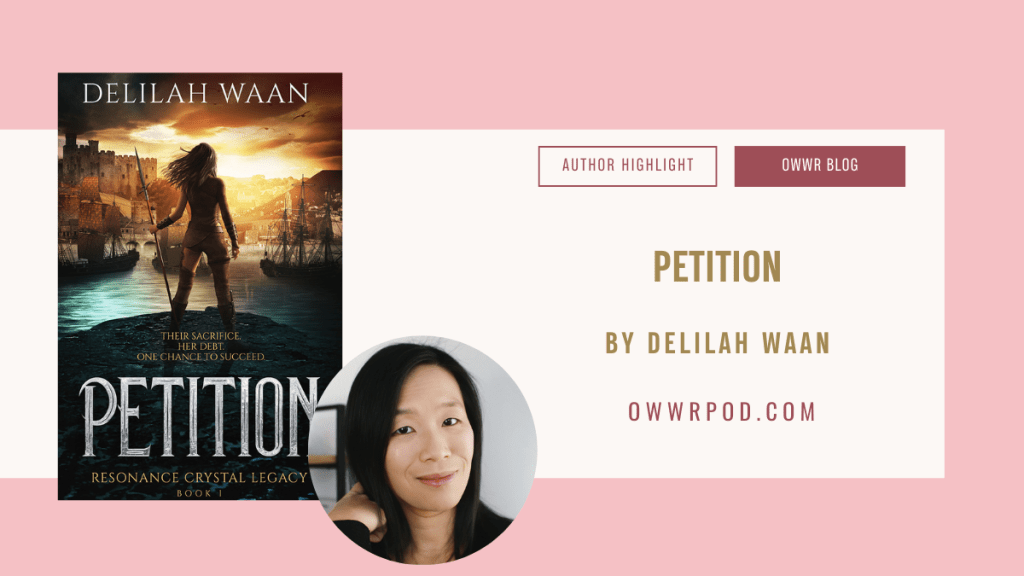
Hannah got to sit down on Zoom with Delilah Waan (all the way from Australia!) to discuss her book Petition and its follow-up Supplicant! It was amazing hearing about her process as an author who streams her writing process. Delilah has created a fiction inspired by her own experience as a child of immigrants, and it has built an amazing work filled with empaths and dedication to family. Check out the end of the interview where we give you some special discount codes to go pick up
- What is your book about?
Petition is a post-magic-school fantasy about an angry Asian daughter of impoverished immigrant fisherfolk who must beat her privileged, “rich kid” rivals in a ruthless job hunt tournament in order to save her family. I generally pitch it as Jade City meets The Hunger Games if everybody’s an empath, but the true influences were Daughter of the Empire and The Traitor Baru Cormorant.
- What made you want to become a writer?
I fell into it mostly by accident. I’ve always been an avid reader but I spent most of my childhood dreaming of becoming a concert pianist and, much later, a composer of Broadway musicals. My Asian parents were…concerned so I went into auditing instead. The urge to be involved in a creative field never went away, so I ended up specializing in tech, media and entertainment. My clients included a few booksellers and traditional publishers. About a decade later, I stopped climbing the career ladder to go into postgraduate education.
During the day, I wrote very corporate things (technical position papers, business proposals, etc) then at night and on weekends, I would work on my Broadway musical. When the pandemic hit, it hit hard and I burned out in a spectacular fashion. I decided that I needed to do something that was purely for myself. I knew by then that I didn’t have the skills to pull off the musical I was working on, so I pivoted to something that had always been on my bucket list and that I thought would be easier: writing a novel. To my surprise, complete strangers on the internet actually read and enjoyed my writing, and wanted more.
- What made you decide to do independent publishing?
I never even considered pursuing traditional publishing, for many reasons. By the time I had something I wanted to publish, indie/self-publishing had been around for many years, and the thing I wanted to publish—bilingual picture books—had a fairly niche market that no traditional publisher was serving. Starting with bilingual picture books proved that it was possible to find an audience as a self-published author, and to self-publish profitably. Once I finished a novel, self-publishing was a no-brainer. Plus I have a pretty cynical view of both the publishing industry and traditional publishers.
Whether or not someone gets published is generally dictated by whether or not the agent/editor/publisher believes they can sell enough of it to be profitable. It was a real laugh, seeing the rest of the world shocked by the witness testimony coming out of the Department of Justice proceedings against Penguin Random House and Simon & Schuster. (My favorite highlights: the CEO of Penguin Random House saying, “Everything is random in publishing. Success is random. Bestsellers are random. So that is why we are the Random House!”, and Judge Pan realizing, “The P&L is really fake.”) I think a lot of the moves we’ve seen from traditional publishing over recent years shows that they’re too big, too slow, and too preoccupied with chasing trends and profitability instead of focusing on what should be their core business: publishing good books.
The more I dug into what being traditionally published is like these days, the more I questioned the value that traditional publishers bring to the table. Yes, they have big marketing and PR budgets (if you’re a lead title); yes, they can get you into bookstores (if the bookstore hasn’t changed policies on what they stock); yes, they’ll get top tier artists and designers (maybe…or maybe they’ll just grab some AI stock to slap on your cover and refuse to change it despite your personal opposition and any public uproar) and editors who will edit your manuscript (if you’re lucky enough to end up with one who isn’t on the cusp of resignation because all editorial staff are so poorly paid and stretched so thin that they don’t have time to do their jobs).
I’ve heard far too many horror stories first hand for me to want to cede the amount of control and the lion’s share of royalties that a traditional publisher demands—and that’s even assuming traditional publishing would be interested. (Chances are they’re not.) As a self-published author, I have full control. If I luck out and find success, great. If I don’t, then at least it’s on me. I can diagnose what worked, what didn’t, and iterate, over and over again, until I find something that sticks.
- What excites you most about your book?
Most books I read growing up were about Chosen One farm boys going on adventures to save the world. The girls were always fair, blonde-haired, blue-eyed, delicate, ballgown-wearing, embroidery-loving princesses. People like me were bit and background characters; exotic ones, if we existed at all. It was years before I found Daughter of the Empire, and recognized aspects of myself in Mara’s story.
Petition is about the immigrant dream. It’s a story that belongs to millions of people all over the world, but one that I never saw depicted in the fantasy genre when I was growing up. While there are more diverse stories being told today, they’re still few and far between, and we live in a time when they are more vital than ever. Stories are how we build understanding and empathy, and prose fiction is particularly suited to exploring a different internal landscape and way of thinking. So what I’ve tried to do with Petition is to write something that lets anybody step into the shoes of an immigrant kid and live the immigrant experience in fantasy form.
- I think it’s so great to read an immigrant story in fantasy. So often it feels like it’s not the case. What was it like writing about an experience similar to your own while building this fantastical world?
Have you ever seen that meme about Picasso? It goes something like this:
A woman walks up to Picasso when he’s in the park and she asks for a drawing. He obliges and says, “That’ll be $1,000.” She immediately objects—“it only took you five minutes!”—and he’s like, “Ma’am, this took me my entire life.”
I could only write and publish Petition in the time frame that I did because it was a story based on decades of my friends’, my family’s, and my personal lived experiences, condensed into one novel. But ultimately Rahelu is her own character and her story takes place in a different world. Once I finished telling the part rooted in my story, I had to move on to the next part of her story, which meant stepping further outside of my own lived experiences. Like 80% of the sequel, Supplicant, is blue water sailing, and the most boat travel I’d ever done at that point was taking a ferry. That required a lot more research.
- What was it like writing Petition and its sequel Supplicant
The first book was hard but the sequel was on another level. Judging by “number of hours spent on alpha revisions”, the sequel was about 14.58 times harder to write (62 hours for Petition versus 904 hours for Supplicant).
The longest piece of original fiction I’d written before trying my hand at a novel was an English homework assignment back in eighth grade (junior high). I found it again recently while going through some old boxes, and it is the most cringe thing in the universe. First efforts at writing usually are, because you have no idea what you’re doing. You’ve no concept of structure, how to craft an effective sentence, or what makes a sequence of events into a story. But humans are born mimics, right? So you start by borrowing bits and pieces that you liked in other things. It ended up being a disjointed tale about a forbidden dark forest that’s forbidden because—well, because it’s called the Dark Forest; that was the extent of my world building. The antagonist was a really annoying boy named after my cousin, because I had just reread The Chronicles of Narnia and was (probably unjustifiably) annoyed at my cousin. I was fourteen. Then a typhoon picked them up and dumped them in the Dark Forest, because it was the late 90s and the US movie Twister was popular on free-to-air TV in Australia.
At this point I got to tell Delilah about Twisters, the spiritual sequel to Twister. I got to describe the Oclahomans who never knew what to do during a twister, even though they live in tornado Alley.
Wait, what? There’s a sequel? Of course there’s a sequel, and of course it doesn’t make sense.
Yeah, that’s why my first attempt at a novel was a fix fic. Approaching it as a learning exercise and having an existing setting, characters, and plot as a scaffold took a lot of pressure off because I wasn’t trying to write a “good” book; I was just trying to improve on the execution. Achieving that gave me the confidence to attempt something wholly original.
With Petition, though, there’s a strange kind of pressure that’s unique to a debut novel. Nobody knows who you are, so there are no expectations and readers are always very generous with debuts. But as the one putting it out into the world, you want it to be something that you’re proud of—except you’re still at the beginning of your journey as an author. At some point, you have to draw the line and recognize that it’s not perfect, but it is as good a book as you know how to write.
Then you get all confident about the sequel because you’re a published author now so obviously you know how to write a novel. But the minute you confront the blank page, it’s suddenly like, oh god, no, no I don’t, I don’t know anything. I felt like a fantasy character who just discovered their magic: I know I wrote a novel, I remember living through the experience of writing the novel, but I don’t know how I actually did it.
The biggest thing I struggled with—and still struggle with—is the inner critic. I livestream my writing, so if you go back to watch the footage of me writing Petition, you will see me typing then make a face where I’m obviously thinking, “Ugh, what a terrible sentence.” I knew from writing the fix fic that if I listened to that inner critic, it would have me obsessing over one sentence for hours, or lead me down a Wikipedia rabbit hole, and I’d end up only writing 50 words and thinking, “I suck at this!” So now I have a rule: if I write a terrible sentence, I highlight it with a comment that says, “I hate this sentence!” and I keep going. If I don’t know what I’m supposed to be writing, I put an XXX placeholder there. XXX can stand in for anything. It could be a character I haven’t named or something I need to research, a particular word choice, or a sensory description. And I move on. That’s how I get to “THE END”. Only then am I allowed to go back and slay those XXX placeholders.
- You said you live streamed this? Was that ever like? Was it incredibly intimidating knowing people were watching your writing process?
Yeah. I’m used to a corporate environment where you spend 8–16 hours a day working in tight-knit teams with lots of high performers around the office you can constantly bounce thoughts off of. Going from that to self-publishing—which is me, sitting in front of my computer every single day, with nobody to talk to but my cat, who doesn’t count—was a huge adjustment. Livestreaming was my attempt at recreating a high accountability environment. Tweeting “I’m streaming on this day at this time, so come join me in writing words” established a public expectation I would be there so I showed up; knowing someone could jump in to watch me at any time during the stream forced me to actually write words.
The other thing is, normally you only get to see a work of prose in its finished form. While you can analyse it, the thought process behind the author’s creative decisions remains invisible. But when Brandon Sanderson released all the drafts of Dawnshard (with anonymized beta reader feedback included), we got the rare chance to get a glimpse of that process. He’s also posted real-time screencasts of him drafting one of the Stormlight Archive interludes. It’s fascinating and invaluable stuff to study, because you can watch him craft sentences in real-time and thus get a sense of what he was thinking. So sharing my screen while I write is both accountability and me paying it forward. And with the prevalence of generative AI these days, it’s also proof that I write every word I publish.
- I think a lot of authors struggle because writing is very vulnerable, but it feels like you’re very comfortable in that vulnerability. And that’s amazing.
It comes from being an auditor. From day one, every workpaper you produce gets plastered in review notes from your senior, your manager, your partner because you don’t know how to audit anything. You learn by doing, and when you inevitably miss something, you learn not to do it again, so you don’t get another blistering review note about the same issue.
I’ve gotten to the point where if I write something and I send it to my alpha readers or my beta readers, and it comes back without being covered in comments, I get worried. It can’t be that good! There should be 50 things wrong with it! I don’t know if that’s the healthiest mental place to be. But there is a Chinese saying, 先苦後甜 (Cantonese: sin1 fu2 hau6 tim4; Mandarin: xiān kǔ hòu tián), which translates to first bitter, then the sweet. I always prefer that. I want the bad news because once you know, then you can deal with it.
- I also noticed a large part of Rahelu’s motivations, as you stated, are focused on survival considering the economy and her family’s position. It makes her take a desperate chance with consequences she may not understand. That is such an honest motivation. Can you tell the readers a bit about that choice for her and how it affects her throughout the rest of the book?
Petition is dedicated to “the families who left everything behind to seek a better life.” That fierce desire, and the hope that there IS a better life for the next generation, is what fuels immigrant families in their day-to-day struggle when they can’t afford to subsist on the little income they have. I think that desperate, edge-of-despair realization of, “I’m doing everything I can, and it is not enough” is a very universal, human feeling. That is how the economic forces of capitalism have shaped our society.
My parents both grew up poor. My mom’s family was her parents and five kids crowded into a tiny apartment in Hong Kong. They all slept in one bed. They ate meat once a year—one chicken drumstick per child. It was such a rare, expensive treat that my mom would eat all her rice first so she could savor the drumstick last. But she’d get full from the rice and, because they couldn’t save it for later, her sister, who had eaten her drumstick first, would get to eat my mom’s as well.
My dad’s family was even poorer. He could either get up at an ungodly hour and walk to school so he would have lunch money, or sleep in and take the bus but go hungry. People might ask: Where were his parents? Why weren’t they taking him to school or making sure he was fed?
Well, his parents had to work. In families where people are struggling under extreme economic pressure, the parents are focused on doing the things the kids can’t. For many families, even though the parents are doing all they can to keep a roof over their heads and get food on the table, it’s still not enough. Responsibility gets pushed down. The kids have to step up. Or the family doesn’t survive.
That’s why Rahelu’s duty to her family always comes first. It’s authentic to who she is, because that is the kind of worldview you have when you grow up with that kind of deprivation, under that kind of pressure. Everything you do, your whole existence is focused on first securing any form of security for your family, and then getting your family out. Since single-minded characters can often come across as 1-dimensional, I tried to show that Rahelu does have other dimensions to her. So there are moments in Petition where you can see she’s had other interests, other desires. But each time her thoughts drift that way, she pulls back to refocus on her family.
It’s a tough balance to strike. Rahelu acts the way she does for reasons that go beyond pure economic survival because she knows her parents gave up their futures for the sake of hers. How do you even begin to repay a debt like that? Rahelu constantly makes bad decisions because she’s internalized that she is the cause of her family’s hardship and her success is the only end that justifies their sacrifice. And I hope that even though readers might disagree with her actions, they’ll understand the how and why of her choices.
- What about your characters excites you?
Getting to explore other viewpoints, especially ones that are very, very different to my own. I like to write in “deep third”—a version of third person limited perspective that gets so close to the POV character that there’s basically no narrator. I write my characters as people going about their lives while encountering other people whose values, motivations and actions they may or may not agree with. And with every action, every line of dialogue, every bit of introspection, I get a little closer to understanding what it’s like to experience the world through their eyes.
That’s the fun part, especially since I never plan out my characters, and they never come to me as fully formed people. I figure out who they are as I write the story. So I don’t think of my characters in terms of whether they’re heroes or villains, or whether they’re morally good or bad or grey, because rarely do people ever stop to think about which of those labels should apply to themselves. (And even if/when they do, how honest are they being, really?)
- I am writing from a deep third person perspective, so I’m here for it! But you’re also a pantser. What was it like finding out what the characters in your books did as you went along? Was there ever a moment they surprised you?
All the time! I didn’t realize I was a pantser for ages because I am that person with a 10 year plan. Thing is, I can smash out an adequate-looking outline perfectly fine; I just cannot stick to it to save my life. When I try to turn outline bullet points into actual prose, my brain goes, “noooooooope, nope, we’re not doing that because it makes no sense for the character/s to do that, they’re obviously going to do [thing that was never on my radar while outlining] instead.”
So what I use is a framework that Mary Robinette Kowal teaches, called the try/fail cycle. It starts with a two-part question: what is the character trying to do, and does it work? The first part forces you to distill high level character motivations down to concrete action as you write each scene, and the second part’s emphasis on consequences forces you to write causally linked scenes that continuously build tension and stakes throughout the narrative. Since you’re always doing that through character choices, it makes for a story that’s both plot- and character-driven.
As I had no interest in writing magic school (I have nothing to add to magic school), I skipped to the next logical point. Once I had the fantasy job interviews concept for Petition, I didn’t worry about my lack of outline as much, because I’ve done loads of interviews in my previous corporate life. So I just opened a blank document and started typing. From there, it was a giant improv exercise; a lot of asking things like, “What do people get wrong when they apply for jobs?” and “What are some of the most common and the worst mistakes I’ve seen people make during interviews?”
Structure-wise, I knew the fantasy analogue was a tournament plot. But who Rahelu meets, how they interact, the obstacles she encounters, what she decides to do—all of that I discovered as I was writing. Most of the secondary characters developed from a single line. An entire relationship subplot developed from a single line. There’s a pivotal decision towards the end that I was dead certain I knew how it would go. Rahelu made the other choice. I didn’t know that would happen until I wrote that line. The beta reader feedback I got was hilarious, because to them, her choice was so obvious, to the point where they didn’t even think there was a real alternative.
- Was there something that was difficult for you with your characters?
The hardest part is always figuring out the right viewpoint and then getting into the viewpoint. If I can’t do that, I can’t get the voice right, so I can’t get the line right, and if I can’t get that line right, everything just goes downhill. I end up hating every word I write. Because every line I write builds on what came before, and I only ever know when the scene is going to end when the characters have finished going through that try/fail cycle and there are no further consequences.
That’s how I got stuck in the middle of the alpha draft for Supplicant, and I didn’t really understand why. Fortunately, Naomi Novik was doing an AMA on r/fantasy for the release of The Golden Enclaves at the time. One of her answers talked about how she starts writing with a voice, a line that leads into the next line, and I went, oh my god, that’s how I write, that’s exactly how I write. Once that clicked, my frustration became way more manageable.
Rahelu is easier to write—partly because a lot of the experiences that have shaped her outlook are familiar, and partly because I’ve spent a lot of time in her head. I don’t have to spend a lot of time interrogating the situation to know how Rahelu would react, and if that’s not the reaction I’m after, it’s easy to come up with alternatives. Other characters are more difficult.
And the more characters I have in a scene, the more difficult that scene becomes to balance, because even if I’m not writing from their point of view, I have to consider their motivations, their values, their point of view, and their throughline in the story and how all of that supports what they do in that scene, otherwise they won’t feel like well-realized people.
Next I have to filter that by what’s observable by the viewpoint character and layer on what they infer. That might be consistent with how the other characters perceive the situation and themselves. More often than not, it won’t be. Once the text of the scene works, I’ve got to double check the subtext also works. There’s a chapter in Supplicant with nine characters interacting, and most of them have hidden agendas and secrets the others aren’t privy to. Tracking and balancing all that did my head in.
- This is a world of empaths. I’m always stunned when writers have a power that lets the characters see different motivations. Was it fun to play with the empathic abilities? Or were there ever times where it was a struggle to not write yourself into a corner?
I’m actually confused why we don’t see empaths a lot more in fantasy. They’re so overpowered. Like Brandon Sanderson has them in Mistborn—he’s even got a scene in The Well of Ascension showcasing how OP empath powers are—but he didn’t go deeper into exploring their powers. He was focused on the other abilities, the ones that more easily lend themselves to write cool action sequences.
But I’m sitting here going, I don’t know, man. I’d bet on an empath against anybody, every time, because can you fight or even use your abilities if somebody is messing with your mind? Like I’m talking about a proper empath; someone who can control and weaponize other people’s emotions. Ariel from Carmody’s Obernewtyn series. Arithon from The Wars of Light and Shadow series by Janny Wurts. The Mule in Asimov’s Foundation series. All of them are singularly, terrifyingly powerful because of their empathic abilities.
There’s also a limit to how many times I can write “character A punches character B” in a way that I feel is interesting to read. With empaths, combat happens on multiple levels which I think is loads more fun. As long as I’ve done a good job with my characters, I will never run out of ways for them to inflict literal emotional damage on each other.
- Something I was also excited to see on your website – this is available via Audiobook! What was that process like as an indie author, working with a narrator, etc.?
Scary, because audiobooks are incredibly expensive to produce, as well as absolutely amazing.
As you’d probably expect from a story told through a diaspora lens, language and perceived cultural identity is an important theme. How you speak, what language you speak, what accent (or lack of accent) you have, whether any of that matches up with how people expect you to sound—it all affects whether you’re perceived as a perpetual foreigner or as someone who belongs. I needed someone who had the lived experience and range to pull that off, which meant there was only one narrator who could do the story justice: Emily Woo Zeller.
I’m not much of an audiobook reader myself, so I was not prepared for how emotional I got while listening to the files during the proofing process. Emily gave every speaking character a unique voice so they all had their time to shine, even if it was only one line of dialogue. She also created custom accents based on my descriptions of how different languages in the setting sound! The language switches—like when Rahelu’s mother goes from placating an angry authority figure with an immigrant’s imperfect command of a foreign language to fluently scolding Rahelu in their native tongue—are perfection. And Chapter 27! I was in tears, wishing I had written less dialogue tags so they would stop getting in the way of Emily’s brilliant performance.
The audiobook adds a whole dimension to the story that I don’t think is possible to get from reading the ebook or print versions. I highly recommend checking it out. I distribute everywhere except for Audible, so you can listen on Libro.fm, KoboPlus, Spotify, and other audiobook platforms, including library lending apps like Libby and Hoopla.
- Can you tell readers what to expect in Book 2 – Supplicant? Or even in books to come?
If Petition is fantasy job interviews, then Supplicant is figuring out the job. Not-spoilers: everything gets harder.
There are currently five books planned in the series. I’ve just started writing the third book, Dedicate, which picks up from where Petition left off and should dovetail with the events of Supplicant. It’ll answer some of the questions we didn’t get to explore in the first two books, then take those to their logical conclusion. At least, that’s the plan.
I have ideas about where the last two books will go, but I don’t want to say much more because I know nothing until I actually write it!
- What books inspire you?
There are many, many great books by amazing authors who inspire me and whose writing I aspire to. But if I’m honest, what really gets me raring to go smash out some words is when I read a book that wastes an interesting premise on a really terrible execution. That’s how the fix fic happened. I read The Blending by Sharon Green and went, I can do better. Whether I did actually execute better on the ideas, I’ll leave as an exercise for the reader. (For those who are curious, it’s available to read on AO3.)
- What are you reading, watching and/or enjoying?
My current favorite book recommendation is Exordia, the sci-fi debut by Seth Dickinson, who is one of my favorite authors. I do not have any non-spoiler way to describe it so here goes with a bunch of superlatives:
Brilliant and deep and dark—so dark—yet funny, and full of hard, theoretical maths and physics, but (and?) also it has objectively evil space snake aliens who come across as legitimately alien rather than cosplaying humans.
- Where can people find you?
You’ll find me most places under the handle @delilahwaan, but I’m generally more active on Reddit, Instagram, and Bluesky. Hop over to my website (www.delilahwaan.com) for my links, sample chapters, and information on where to find my books. Signing up for my newsletter gets you exclusive access to a deleted short story prequel. No spam and no ads; just a monthly write-up of what I’ve been working on and what I’ve been reading.
I also publish Cantonese/English bilingual rhyming picture books via my other imprint, Catlike Studio (www.catlikestudio.com). For those who are interested in the business side of publishing, I do long form videos and daily writing livestreams over on my Paper Tiger Productions YouTube channel (https://www.youtube.com/@PaperTigerProductions/)
- If you liked what you read, please check out Delilah’s works using these coupon codes! You can get them from her website, Barnes and Noble, Google Play, or Smashwords!
Discount codes
Direct store: OWWRJUL2025
– https://www.delilahwaan.com/shop/
– this is valid for all the ebooks and the audiobook as well
Major retailers:
– Google Play (ebook only): DEJY5SGYJ3G2W for most regions; GM68CJMN0VZ5T for Hong Kong, India, Indonesia, Japan, Malaysia, Philippines, Singapore, South Korea, Taiwan, Thailand, and Vietnam.
– Barnes & Noble (ebook only): BNPOWWRJUL25
– Smashwords (ebook only): JUXHN

 On Wednesdays We Read Podcast
Leave a comment