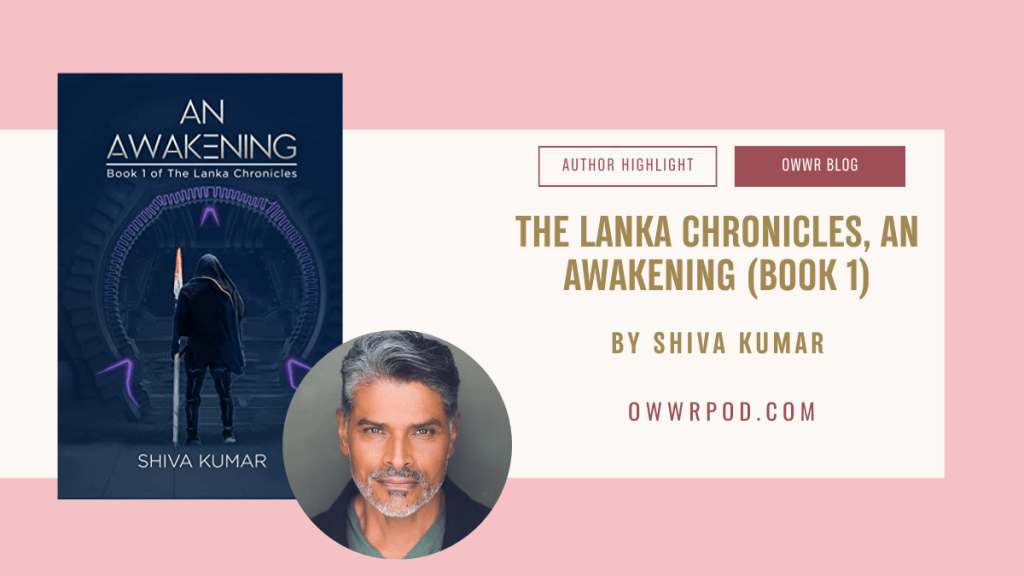
I, Laura, got the chance to interview Shiva Kumar about book one in his series, The Lanka Chronicles, a sci-fi saga that mixes mythology with space opera and futuristic technology!
Below are parts of prefilled questions as well as our discussion!
- What made you want to become a writer?
I started this journey back in 2015. I remember I was in my editing studio working on final post production on a documentary, when I received a call from my doctor urging me to come in to confirm their finding cancerous cells in my body. It felt surreal, a sort of out-of-body experience. On the trip to the doctor’s office, I vividly recall a waking dream. As a lover of the great Indian classics like the Ramayana and the Mahabharata, I imagined the hero of the Ramayana, King Rama, as an older man, haunted by actions he took as a younger man, actions that made him the great hero, adored, and respected by all but those very actions hurt so many and destroyed his one true love. I saw his nightmare, I felt his pain, I understood his need to find redemption for his past misdeeds.
That’s where it started. My diagnosis, the surgery, the subsequent chemotherapy, and the radiation treatment, all took a backseat to my needing to commit this story to paper. I wrote feverishly, starting with his bad dreams and working my way back from this older guilt-ridden monarch to the young hero whose decisions led to this hollowed out man seeking redemption. The very act of writing strengthened my resolve to not allow my own medical procedures to take center stage in my life. My writing became my sheath of armor, my ivory tower, my garden of delight, protecting me, healing me, and allowing me to experience the joy of pure creation.
- Did working on this story help you during your health journey? Was it ever difficult to be working so hard on this during a vulnerable time in your life?
I have to say that it saved me, in the sense that it gave me something other than my medical diagnosis to focus on. As you probably know, in India, the Ramayana is considered by most Hindus, including my parents, as a religious text. My father said it was the divine hand of god guiding me on this endeavor. Maybe, I don’t really know. I do know that I felt like I was a conduit and the story just poured out of me. I couldn’t wait to get back each morning to find out where the story was going to take me. I was so razor-focused on wanting to get this story written down that everything else took a backseat. There were times that the repercussions of my chemotherapy and radiation treatment made me too exhausted to write, but those were few and far between.
That was when I realized how much joy I was getting from writing this story, that ended up becoming a trilogy that I switched over to writing full time. It took a decade to get the three novels finished and published but they are now out in the world. I have since written a screenplay and another mythology-based horror and have a few other stories drafted out.
To me now, my life is a gift. I cherish every moment and weigh what one might consider a tough moment or a rough period in one’s life with the idea of not being alive and that puts things in perspective. You can choose to see the glass as half empty or half full. You have no control over external elements, natural disasters, the stock market, getting laid off, or getting cancer, but you do have control over how you react to it. Whether this life is all we have or if we come back to live again, what we know for sure is this life and we have to try and live it to its fullest.
- What books inspired you to write?
There are so many. Frank Herbert’s Dune saga was one of the inspirations for my trilogy. I love Ursula Leguin’s Left Hand of Darkness. I have been inspired by Julian May’s Pliocene Saga, Brian Lumley’s Necroscope series, Tolkien’s Lord of the Rings, Donaldson’s Tales of Thomas Covenant the Unbeliever, The Expanse, Zelazny’s Lord of Light, Burroughs John Carter of Mars and I can go on and on.
- What draws you to science fiction as a genre?
When I was a boy, I loved reading world mythologies, fantastic stories, epics from Indian mythology, horror and fantastic fiction and l used to entertain my siblings and cousins with scary stories that I would act out with character voices, and sound effects.
I came from India to America when I was 14 yrs. old. It was 1974 and while America was going through a very difficult period with inflation, racial tension, and urban crisis, I was in heaven. New York City was gritty, alive, and vibrant. The public school I attended was wildly diverse and I was embraced for my differences.
I devoured comics, pulp fiction and fantastic stories. I saw a natural progression from those old epics of India to the ‘Lord of the Rings’, ‘Tarzan of the Apes’, ‘John Carter of Mars’, ‘Conan the Cimmerian’, ‘Elric of Melnibone’ and countless other fantasy stories I absorbed in my teenage years. Thor and Wonder Woman are popular comic characters that originated in Norse and Greek mythology. Neil Gaiman with his Sandman comics and ‘American Gods’ explored ways to make ancient gods and aspects of our subconscious relevant to our lives today. I have tried to tread similar ground with my Lanka Chronicles trilogy.
There have been more than a few occasions, when avid reader friends of mine have said that they don’t read science fiction or fantasy, only literary fiction. For me science fiction and fantasy are ideal vehicles to explore the human condition. In all genres including literary fiction there are books that are no more than simple escapism, that are sweet and on the surface. But the Lanka Chronicles is not escapism or just a light hearted space opera. Regardless of genre trappings, a story that explores the human experience will always connect with an audience. I use the term Existential science fiction to describe my trilogy. It’s a deep look into the nature of our existence and asks questions about love, morality, and the meaning of our existence in a mythical/futuristic setting. These are all the hard life lessons I have learnt living on earth for the past 6 decades and counting. My hero, Dharma’s journey to find redemption mirrors my own journey to create something that will outlive me, that will represent me, that will be a legacy for my children and grandchildren to know me.
- Can you tell us a little bit about your book?
Combining classic science fiction, epic fantasy, and grand mythology Kumar composes a saga of expansive vision, human frailty, twisted ambition, remarkable aliens, sentient machines, fallible gods, and a quest for redemption.
The trilogy follows Dharma, leader of the New India Federation of Planets. 30 years earlier, Dharma fought a Great Battle on the planet Lanka, where he lost his wife under mysterious circumstances. He receives a secret message from Lanka and sets out on a mission in hopes of reuniting with his wife, Arya, and atoning for his past. The story is told from the point of view of Maya 1, the first sentient starship on her own voyage of discovery. Through Dharma’s dreams, Maya 1 uncovers his traumatic history and realizes her search for meaning is linked to his story.
The Lanka Chronicles is as much a spiritual odyssey as an exciting space opera. Book one explores a space-faring culture and futuristic technology. In book two, the characters crash on a planet and lose their technology, forcing them to adapt to harsh conditions and primitive tools. Book three comes full circle where prophecy, technology, magic, and the grand design are revealed in an epic conclusion.
- Tell me a little more about world-building in your books. What is the planet Lanka like? What kinds of alien species are present and how did you develop them?
Allow me to go back a bit further to provide my worldview that informed my world-building. Given where we are as a species today, I tried to extrapolate as to where we might end up, if we continue in the manner we have for so long. Our resources are dwindling, our climate is becoming unpredictable, our food sources are disappearing, and our population is growing. Soon we will have nowhere to go except up and out. The low-lying areas of the world, including all of South Asia, are particularly susceptible to climate change and may very well be under water in the next few decades. Also, India with a population of 1.6 billion souls, is known as a hub of AI development, computer technology and has proven to be able to mount efficient and low-cost spacecraft that have made it to Mars. If there was any country that needed to find a way to develop spacecraft that could colonize the Moon or Mars, India would be a major contender. Once I had worked that out, I needed to chart out the multi-generational saga timeline starting with our hero’s grandfather and working to our hero. Our hero Dharma’s grandfather, Aja Raghav, the founder of the modern Indian space program successfully launches the first rockets to colonize other planets around 2167 A.D. The bulk of the story takes place around 2294 A.D.
The story is told from the point of view of Maya 1, the first sentient starship. The trilogy follows Dharma, the Prime Minister of the New India Federation of Planets. 30 years earlier, Dharma fought a Great Battle on the cloaked planet Lanka, where he lost his wife under mysterious circumstances. He receives a secret message from Lanka, which might be from his long-lost wife, and so sets out on a mission in hopes of reuniting with Arya and atoning for his past.
Through Dharma’s dreams, Maya 1 uncovers his traumatic history, realizing her search for meaning is linked to his quest.
Over the course of the three books, we see Maya trying to understand human behavior. She comments on the irrationality of humans, yet finds their desire, passions, and capacity for fierce and passionate love inexplicable but admirable. She states that she would like to experience love. In fact, as she delves into Dharma’ and Loki’s dreams and memories, she finds herself becoming protective of them. She wants to nurture them, mother them, love them, as a parent or even as a lover. She wants to understand love and why humans will go to such lengths to attain it and destroy it. Maya gives us an opportunity to hold a mirror to our irrational human tendencies. We go to war, while professing to follow God’s laws. We destroy our planet knowing it’s all we have. We extinguish the possibility of love because of our insecurities and fragile egos. Yet, Maya still finds much to admire about us humans.
There is a powerful spiritual component to the trilogy. Our hero Dharma represents the empirical, scientific, and rational 23rd century, man of reason. He sees colonizing and terraforming planets as a logical method to help mankind expand beyond the confines of a depleted Earth. His wife Arya believes that the universe in not an accident, but a purposeful creation and that colonizing and terraforming planets is essentially raping and pillaging them, repeating the cycle of violence mankind has perpetuated on Earth and on their own kind. But until they crash on the planet Lanka, this discussion is largely theoretical.
As I mentioned earlier, the Ramayana, a 5000 year old epic poem is revered in India as a religious text. It is filled with astounding and magical beings, warring gods and heroes with godlike powers. In ’The Lanka Chronicles’ I tried to provide plausible scientific explanations for many of the miracles in the original text. In my story our heroes are normal humans from the 23rd century who land on a planet that has a core power that the beings of this planet call Prana. Prana is the Sanskrit word for Life breath. Prana can be used to heal or to corrupt. This power can be seen as magic or as any natural form of energy surrounding all planets. Dharma’s wife, Arya, vibrates at a higher frequency than others so can hear the song of the planet. Quantum physics suggests that at the core of all matter is a common particle and it is the different vibrations of this particle that forms all matter in the universe. This idea of matter vibrating at a particular frequency gave me the idea of seeing a plant having a chorus or a harmony that is a ceaseless and perfect note. When corruption enters, the eternal sound becomes disharmonious or out of tune. The indigenous peoples of this planet see this harmony in colors. Each indigenous species has a different color aura. The humans see this harmony through sound and data. Dharma as a modern human comes to recognize that the universe is made up of data and like a computer program, when an anomaly enters, it corrupts the code.
Book 1 – An Awakening is more science fiction than fantasy. Most of it takes place in a planet-hopping, star-cruising 23rd century. This book is a perfect example of what I call Indofuturism. A relatively new term that describes a future where India becomes the first space faring nation.
In Book 2 – A New Reality our main characters crash on a planet and lose all their modern technology, forcing them to adapt to harsh conditions and primitive tools. They rely on crude medieval tools and weapons to survive. The indigenous species of the planet Lanka are startlingly different from anything they have encountered before. The Gridhra look like large prehistoric birds and are the philosopher guardians of the planet, massive humanoid looking bears called The Hriksha stay hidden in the western hemisphere of the planet, and human sized simian beings called the Vanara live in vast forests in the southern hemisphere.
And Book 3 – Path of Destiny comes full circle where prophecy, technology, magic, and the grand design are revealed in the epic conclusion.
- Science fiction often speculates on the future and the definition of humanity. Would you say that your work also questions these themes? Are there specific themes within your books that you are particularly drawn to?
Yes, very much so. I can narrow my trilogy down to three themes.
- Indofuturism – A plausible scientific exploration of where South Asia and India in particular might be as we contemplate the destruction of the only habitable planet we know of.
- Existential Science fiction – A deep dive into the nature of our existence and asking questions about love, morality, duty, compassion, our humanity and the meaning of our existence in a mythical/futuristic setting.
- Our Moral Compass – Many of the ancient legends across all our many cultures are filled with great (almost exclusively male) heroes who go on fantastic quests, face incredible odds, and perform superhuman feats but the collateral damage they leave behind is often staggering. Countless thousands die on the battlefield, pining wives wait in vain, daughters are sacrificed to the gods, unearthly demigoddesses are bedded and so on. I always wondered, if those heroes lived to become older men, would not the guilt of what they did haunt them? Would they not want to atone for their many misdeeds? As I was navigating my own illness, I realized I wanted to tell the story of The Ramayana from the point of view of the hero as an older man who wants to atone for his sins.
The updated lessons that I hope my trilogy will reveal are ones about our fallible, uncertain, questing and striving human nature. Gods have the luxury of being perfect. Humans do not. Most of us muddle through life trying to do our best but even when we aspire to be good, moral, loving, and kind we falter. Our egos, prejudices, fears, and petty nature are obstacles to becoming our best selves. As we get older, we reflect and try to understand our motivations better. We try to recognize our weaknesses and failures and try to become better versions of ourselves. By trying to humanize the heroes of the Ramayana, and using the AI spaceship, Maya 1 as a narrator, muse, and reflector, I hope a modern readership will relate to this story, fall in love with these human characters with flaws and recognize the grandeur and scope of this seminal epic from India.
- Can you tell us a little more about the technology in the series and what it was like to develop this?
Arthur C. Clarke said – Any sufficiently advanced technology is indistinguishable from magic. Asimov’s Foundation series depicts a future after technology crumbles and for a thousand years humanity lives in darkness. When programmers revive old computers people assume it is magic.
As far back as we can go with our stories, there have been countless depictions of other worlds, advanced civilizations, strange weapons, and alien beings. I read a wide range of sci-fi and fantasy stories but took the bulk of my inspiration from Frank Herbert’s Dune. I wanted the technology of my world to feel widely accepted, used, and integrated into everyday life. We don’t comment too much on the televisions we watch, the cars we drive or the planes we fly. But despite all our technology, we are, by and large, a religious or spiritual race seeking answers to all the big questions. Who are we? Why are we here? Are we the only ones? Is there a god?
In The Lanka Chronicles, the technology of the 23rd century is recognizable as an exponential extension of our present technology. But the cloaked planet Lanka has some sort of force field that inhibits all modern technology. This planetary power is called Prana. Is it sentient or is it just a scientific phenomenon is a question our heroes grapple with. Prana infuses all the races of Lanka. They live in harmony with the planet and are at peace.
A group of 300 members of a religious cult stole a spaceship a century before our heroes are born and find their way to the planet Lanka, their promised land. Without modern technology, they live for a period as hunter gatherers. Over time they recognize that the Prana in the blood of the native species has the potential to power their 23rd century technology. They quickly enslave the Vanara tribes and start to distill their blood to power their machines. However they are only able to distill a corrupt version of Prana they call Ajeeva. Ajeeva is the opposite of Prana and corrupts the user. The original 300 called The Asura become malformed, vicious and evil.
I am attempting to find the place where science and spirituality meet, and quantum physics can be interpreted from both a scientific and a spiritual perspective. I tried to find plausible explanations for events and occurrences that might otherwise seem like magic. Dharma and his brother Loki are men of reason and science and do not accept spiritual explanations. Arya on the other hand believes there is more to the universe than science can explain and as time passes, she becomes a conduit for some of these unexplained occurrences.
- In the book you utilize historical logs and reflections to tell the story. What made you choose to paint the story this way?
The Ramayana is a very long epic poem. It is told from an omniscient point of view. In keeping with modern storytelling conventions, I needed to tell the saga from a very close 1st person point of view. But there was so much background information that needed to be conveyed. Maya being A.I., has the ability to go into Dharma’s and Loki’s dreams, piece together missing bits of information from her data banks and present a fuller picture than any one character could provide. But Maya is not just a convention to propel the narrative. Her own destiny is a significant part of the story. She is aware that her quest is tied to Dharma’s journey for atonement. Maya 1 is the first of her kind, a sentient spaceship who wants to understand her ultimate purpose.
- What was it like to incorporate the mythology into the novel? Did it seem to fit into the story pretty naturally?
Yes. I have great love and reverence for the original text and its many variations. I wanted to pay homage to the Ramayana while approaching it from a 21st century perspective. Archetypal mythologies continue to resonate because each time they’re told, the politics, economics, culture, and spirituality at the time of their dissemination, informs the re-telling. I hope those who are familiar with the original text will recognize all the major beats of the story that I have kept intact but approached it from a modern psychological perspective.
The Ramayana is probably the most popular story told in South Asia. During the Indian festival of Dussehra, The Ramayana is sung by bards and storytellers over a ten-day period using puppets, effigies, actors, and multiple staging effects. One of the abiding origins of our festival Diwali is that it is the celebration of Rama’s triumphant return home after rescuing his wife Sita from the Rakshasa King, Ravana. Rama is acknowledged by most Indians as the avatar of Lord Vishnu who has come to earth to teach mankind how to live a righteous life. So, he is seen as the ideal man and his wife as the ideal woman.
- Was there much research involved in crafting your book?
All 3 books of my trilogy were written at one time between 2015 and 2017. The overlay of an older Dharma going back and trying to atone for his actions, were my addressing what I saw as problematic portions of the original legend. Of course, it was written 5000 years ago and has been rewritten countless times to reflect the politics, culture, and spirituality at the time of each iteration of the legend.
I went back to many different versions of The Ramayana. There is the Valmiki version, which as far as we know is the original and written around 1500 BCE. Another popular version, The Tulsidas Ramayana was written around the 15th century. What changed from the original version is the divinity of the main characters. Valmiki’s Ramayana considered the characters human beings. By the time you get to Tulsidas they were seen as divine beings. There are also many regional versions of the story. Depending on the region and their specific culture, the characters morphed to represent those traditions.
The Ramayana has hundreds of interpretations, not just within India but across all South Asia. There are versions of the tale in present day Sri Lanka that depict the demon Ravana, Iraivan in my story, as the cultured and benevolent monarch, who justly ruled his kingdom and that Sita, Arya in my story, was actually his daughter, kidnapped by barbarian invaders from the north. Ravana wages a just war against Rama and his barbarian hordes dressed like apes and bears and triumphantly brings Sita back home.
There are different versions in Thailand, Indonesia, Cambodia, Burma, and China. I tried to take all this into account to paint a fuller, more nuanced version of this popular epic. Maya 1, the sentient spaceship has a key role to play in this updated reimagining of this ancient tale. Those who are familiar with the original tale will immediately see where and how my story differs and adds to the understanding of the original text.
- What made you pick Indie Publishing?
The reality of the publishing industry is sobering. There is so much being written by so many people every day that trying to find an agent, then an editor, and a publishing house is quite daunting, especially if you are a debut author with an unfamiliar title. Also, most agents want reasonable certainty that they can sell your book to a publishing house. They all want the next whatever is the ‘flavor of the month’ because they can sell that. Going indie is tough but it is organic and slow, and you build a passionate audience who connect with your specific work. And if the first book is a success, agents will find you.
- What excites you most about your story?
I have great love and reverence for the many original texts and it’s many variations. I wanted to pay homage to the Ramayana while approaching it from a 21st-century perspective. Archetypal mythologies continue to resonate because each time they’re told, the politics, economics, culture, and spirituality at the time of their dissemination, informs the re-telling. I hope those who are familiar with the original text will recognize all the major beats of the story that I have kept intact but approached it from a modern psychological perspective. I am attempting to find the place where science and spirituality meet, and quantum physics can be interpreted from both a scientific and a spiritual perspective. I tried to find plausible explanations for events and occurrences that might otherwise seem like magic. My main protagonists, Dharma and his brother Loki are men of reason and science and do not accept spiritual explanations. Arya, Dharma’s wife, on the other hand believes there is more to the universe than science can explain and as time passes, she becomes a conduit for some of these unexplained occurrences.
- What excites you most about your characters?
I have lived with this story for a decade now. My main characters, Dharma, Loki, Arya, Maya, Iraivan, and Hanu-man are all facets of my thoughts, my personality, and my worldview. They represent different aspects of my character. I have come to love these entities as they took on a rich life of their own, guiding me towards their truth. Dharma’s journey to find redemption mirrors my journey to create something that will outlive me, that will represent me, that will be a legacy for my children and grandchildren to know me.
- Did you enjoy writing from the point of view of a starship? Was it ever difficult to craft this character?
Yes, very much so. Maya 1 is the Greek chorus and interestingly enough, the moral barometer of this narrative. Her logs explore our fundamental contradictions. She asks the questions, we the reader are pondering as we read the story. Her story is inextricably linked to the Lanka Trilogy narrative. I could not have written this story without her POV.
- What was something you struggled with in the writing process?
I was so new to the world of writing that I knew very little about how to get a book properly written. I just wrote from a stream of consciousness till I had all three books written in one big tome. Then I separated them into 3 volumes and took a few online seminars on writing. I reworked my first book about a dozen times till it started taking some shape. I had a few friends read early drafts and make comments. I joined a writing group, and we reviewed each other’s works. Then I did hire an editor, which by the way, I wholeheartedly recommend. We are too close to our work to edit it properly. An editor can see blind spots, personal biases, repetitions, sensitivity issues and so many other things we are blind to as we read our own work. I changed the gender and age of some of my characters to have a more balanced cast. I worked on a consistent POV for each character and eliminated as much ‘head-hopping’ as possible. After that, I reworked the book another 3 or 4 times, and finally, before it went to print, I hired a proofreader for small grammar, punctuation, and syntax issues.
- What advice would you give to other writers or even writers who are new to the genre of science fiction?
Any creative endeavor we undertake requires discipline. Making films is an all-consuming, creative, technical, and financial undertaking. Being an actor takes tremendous commitment, confidence, resilience, and humility. But being a writer is the hardest because unlike the other two, until you are ready to show your work and get feedback, you are toiling all alone. It is isolating and terrifying but also tremendously gratifying. You get to play God in your small world. You fall in love with your characters and after a while, it seems like they are writing themselves. Once you find their voice, they tell you what they want to be. There have been some 14-hour days where I have felt like a conduit for some divine energy that is pouring out through me and filling the screen with words. I can’t seem to write fast enough. That is what makes writing such a passionate art. But do it because you want to write, not to become famous or to make money, though if that happens, awesome! Write because it gives you joy.
As for genre, that is subjective. Some writers are called to fantasy or science fiction, horror, thrillers or westerns. They are all worlds within which you can unravel your specific story. I also think once you write in one specific genre, you might find writing in a different genre equally satisfying. It’s all about the story.
- Do you have any projects that you are currently working on that we should be on the lookout for?
Yes. I have written a screenplay called ‘Journey to Babylon’ and it is now in pre-production. Here is what’s called the logline for the film.
With a heartfelt nod to the wonderful films of Edward Burns, echoes of Richard Linklater’s ‘Dazed and Confused’ and Meera Nair’s ‘Namesake’, ‘Journey to Babylon’ is a funny, bittersweet, coming of age story of a creative and artistic sixteen-year-old boy from India who, like every other Indian immigrant, is expected to become a doctor or engineer. Set in 1976, Rishi is invited to his first ever wild summer pool party in very insular, very white, Babylon, Long Island. Trying desperately to belong, to be cool and to be accepted, Rishi’s zany weekend becomes a crucible, where he discovers his truth, his dreams, his place in this brave new world and his own unique take on the American dream.
An interesting factoid is that the 16 yr old hero of ‘Journey to Babylon’ is in the early stages of imagining a complex science fiction fantasy world that reimagines ancient Indian mythology in a modern way. He is torn because he wants to be creative but his family wants him to become a doctor. That boy will eventually write ‘The Lanka Chronicles’.
The other project I have completed is a fine draft of a standalone novel titled Ratri the Cursed. It’s a contemporary urban horror fantasy derived from Indian mythology. The basic premise is that an ancient succubus demon cursed by the goddess Kali at the dawn of time, is unwittingly released from her eternal prison by a fleeing Anglo-Indian soldier in 17th century British India. The demon kills and devours all the hiding soldiers except for the young Anglo-Indian who manages to escape. Believing he holds the key to release her from her eternal curse, Ratri tracks the soldier and his descendants over the centuries and across continents until she finds the last descendant living in a broken-down tenement in the East Village in 1980’s New York. Rohan Campbell, a happy-go-lucky, clueless 20 yr. old part time student and aspiring rock and roll musician is about to have his life turned into a living hell.
- What are you reading, watching, and/or enjoying?
I just finished Fallout and liked it. I was quite impressed with the Foundation series, The 100, See, and For All Mankind.
- Where can people find you and your work? (socials, website, etc)
My website is – shivakumarauthor.com
All three of my books are out on Amazon
An Awakening – https://a.co/d/0b06JR0f
A New Reality – https://a.co/d/07eyMHKG
Path of Destiny – https://a.co/d/01OAu7nJ
IG – https://www.instagram.com/shivak28/

 On Wednesdays We Read Podcast
Leave a comment